tweetindex
DE

Nikolaus Kriegeskorte ✓

@KriegeskorteLab · joined 30 Jun 2014

Vision, neural networks, and open brain science. RT means "This may deserve more attention". Like means "I have read this (e.g. paper) and think it's solid."

10 117Followers
3 078Following
4 841Posts total
29KViews on collected posts

Neueste Beiträge

@TalGolanNeuro @SchuettHeiko The paper appeared today in @NatRevNeurosci. Full text: https://t.co/fKcHgvfjuV 372 views · 6 likes · 1 reposts · 0 replies Open on X →
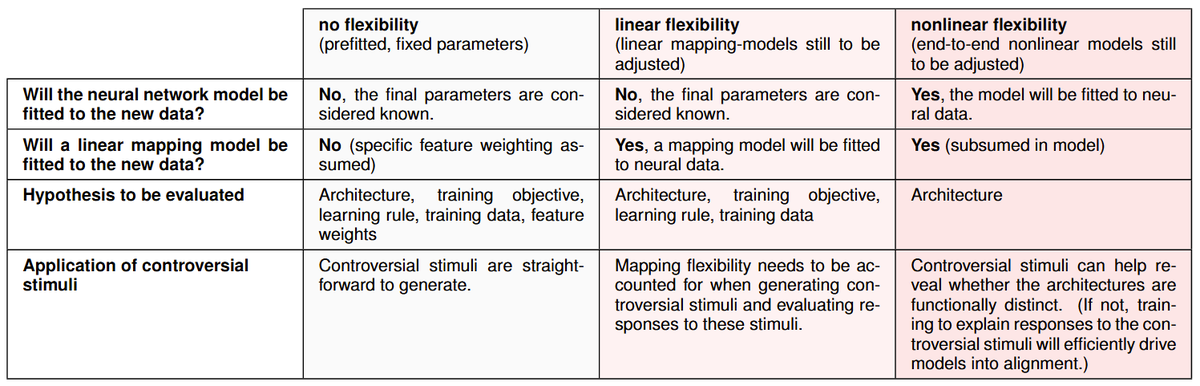
@TalGolanNeuro @SchuettHeiko Making models disagree is a key challenge of computational neuroscience & takes on a new quality now that we are expressing our theories in NN models. “True” models may always be elusive, but we can make progress by comparing imperfect models with car 338 views · 2 likes · 0 reposts · 1 replies Open on X →
@TalGolanNeuro @SchuettHeiko The small number of studies that have used optimized stimulus sets to adjudicate between models have taken heuristic approaches, which we also review in the paper. @TalGolanNeuro tweeted a summary https://t.co/4BEo6mKk2K. 351 views · 2 likes · 0 reposts · 1 replies Open on X →
@TalGolanNeuro @SchuettHeiko A key consideration is to what degree of certainty we assume over the parameters of our models. If we compare models with fixed parameters, model adjudication is easy, but we may reject models that are salvageable by minor reweighting of their represe
203 views · 2 likes · 0 reposts · 1 replies Open on X →
@TalGolanNeuro @SchuettHeiko Explicitly or implicitly, our choices define a prior over stimuli that constrains the explanatory scope of model evaluation. Since our models are far from offering unified explanations, it’s important to adjust the scope of our explanatory ambition to 190 views · 1 likes · 0 reposts · 1 replies Open on X →
@KriegeskorteLab @TalGolanNeuro @SchuettHeiko Why not just compare how well models account for psychological experiments that characterize specific properties of biological vision? These successes/failures are interpretable (e.g., model A captures gestalt principle X not Y). How 218 views · 1 likes · 0 reposts · 2 replies Open on X →
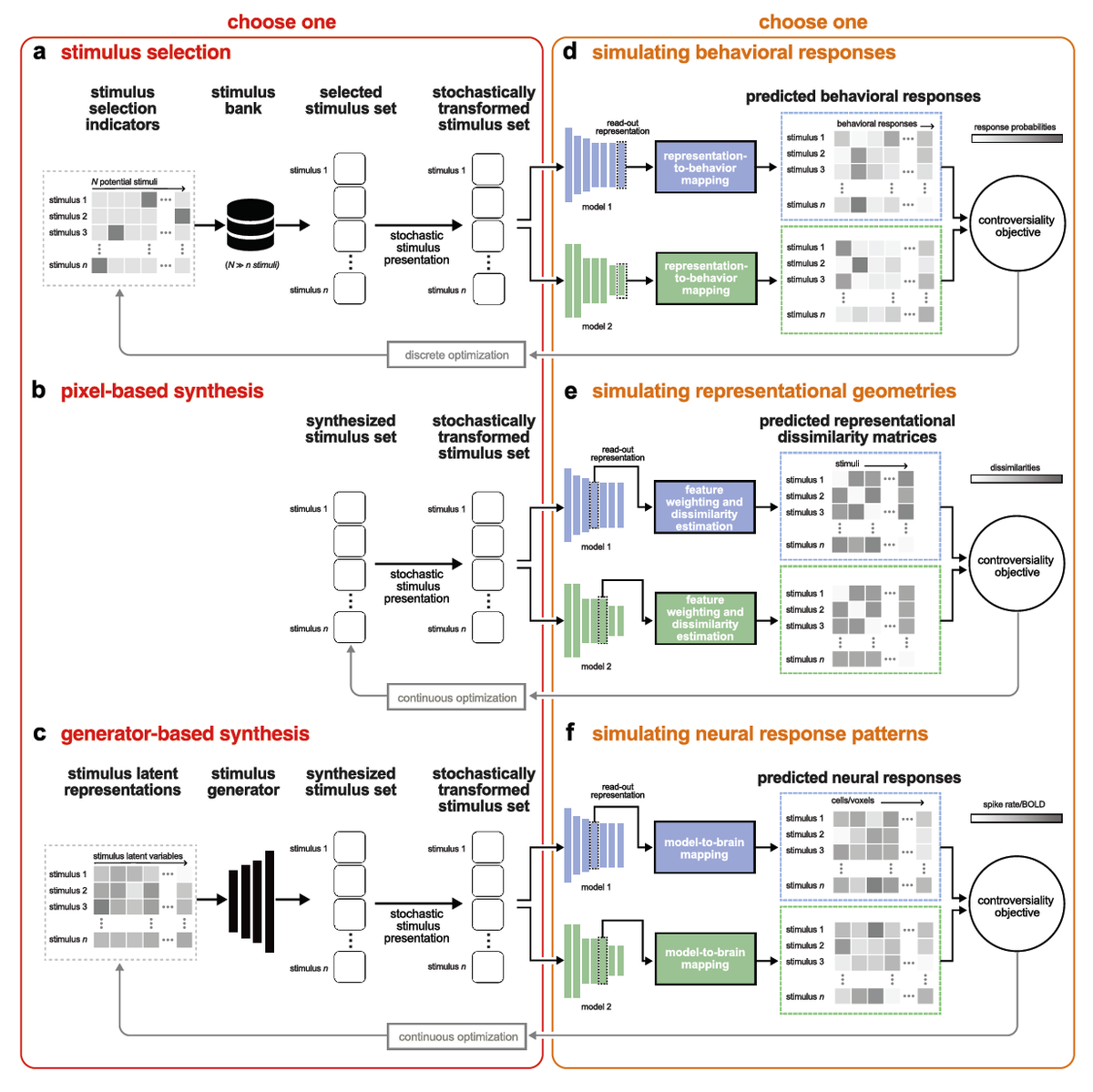
@TalGolanNeuro @SchuettHeiko The paper also explains how to make NN models disagree in practice. Beyond stimulus-computable models, we need to pick an optimization objective that quantifies how controversial a stimulus set is among the models, a stimulus search space and an optim
201 views · 2 likes · 0 reposts · 1 replies Open on X →
@TalGolanNeuro @SchuettHeiko If we choose a stimulus set that achieves good discriminability even in the worst case, we will be able to discriminate all models no matter how confusable their parameters render them. 195 views · 1 likes · 0 reposts · 1 replies Open on X →
@TalGolanNeuro @SchuettHeiko For a given stimulus set, we can estimate the worst-case confusability for all pairs of models and corresponding parameter vectors. https://t.co/5H5AtYMKzQ
197 views · 1 likes · 0 reposts · 1 replies Open on X →
@TalGolanNeuro @SchuettHeiko The frequentist perspective on optimal experimental design suggests a third approach: directly maximizing the discrepancy between the distributions predicted by different models. 195 views · 1 likes · 0 reposts · 1 replies Open on X →
@TalGolanNeuro @SchuettHeiko This motivates maximizing the model-recovery accuracy: The chance of finding the true model given the actual inferential method we will use for model comparison. https://t.co/9isHA2hycd
206 views · 2 likes · 0 reposts · 1 replies Open on X →
@TalGolanNeuro @SchuettHeiko It is often already too hard to do Bayesian inference about our models given a particular data set! If we won’t use Bayesian inference in analysis, designing our experiment to maximize the EIG is not well motivated: It doesn’t optimize our chances of 208 views · 0 likes · 0 reposts · 1 replies Open on X →
@TalGolanNeuro @SchuettHeiko In practice, the Bayesian normative EIG is difficult to estimate because it requires an expectation over models, their parameters, and all possible data sets that our candidate stimulus set might generate. And that’s just for evaluating one candidate 217 views · 2 likes · 0 reposts · 1 replies Open on X →
@TalGolanNeuro @SchuettHeiko However, the outcome y is unknown and depends on the true model m and its parameters θm. The expected information gain (EIG) is therefore the expectation of u(𝛏, y) when the model, its parameters, and the resulting experimental outcome are drawn from
228 views · 2 likes · 0 reposts · 1 replies Open on X →
@TalGolanNeuro @SchuettHeiko For a given stimulus set 𝛏 and experimental outcome y, the information gain is the entropy reduction of our belief distribution over models M: https://t.co/NRSkNfmKWZ
240 views · 3 likes · 0 reposts · 1 replies Open on X →
@TalGolanNeuro @SchuettHeiko If we have a prior over all possible computational models (model index m), we can maximize the reduction in uncertainty (= information gain) afforded by an experiment with stimulus set 𝛏. 274 views · 2 likes · 0 reposts · 1 replies Open on X →
@TalGolanNeuro @SchuettHeiko We approach the problem from first principles: the normative perspective of Bayesian optimal experimental design. This normative perspective turns out not to be a realistic proposition in practice, but it serves as our north star. Let’s consider what 283 views · 3 likes · 0 reposts · 1 replies Open on X →
@TalGolanNeuro @SchuettHeiko When we optimize a stimulus set to make the models disagree in their predictions, we can think of the stimulus set as *controversial* among the models. 288 views · 3 likes · 0 reposts · 1 replies Open on X →
@TalGolanNeuro @SchuettHeiko Our goal is to compare competing models, so we need experiments that elicit contrasting predictions from models: critical experiments. This is a classical problem of experimental design, which we consider in the modern context where our hypotheses are 315 views · 4 likes · 0 reposts · 1 replies Open on X →
@TalGolanNeuro @SchuettHeiko Despite their parametric complexity, neural network models have distinct inductive biases that can be elicited with out-of-distribution probes. 578 views · 3 likes · 0 reposts · 1 replies Open on X →
@TalGolanNeuro @SchuettHeiko Neural network (NN) models have many parameters, and the resulting flexibility can make models difficult to discriminate empirically when they are trained and tested within the same distribution. 694 views · 2 likes · 0 reposts · 1 replies Open on X →
To learn how brains compute, we need to experimentally adjudicate among competing computational hypotheses. How do we do this in the age of complex neural network models? New review paper: “Making models disagree to learn how brains compute” with @TalGolanNeuro, @SchuettHeiko 7.7K views · 90 likes · 25 reposts · 3 replies Open on X →
How can we design experiments that make models disagree? One section of our new @NatRevNeurosci Review with @KriegeskorteLab and @SchuettHeiko examines studies that used stimulus sets designed to elicit distinct predictions from competing models. Full text link at the end. 1/14 5.1K views · 55 likes · 25 reposts · 1 replies Open on X →
Talk videos of the amazing workshop "Toward AI with Human Level Efficiency" organized by Ilker Yildirim et al. at Yale... https://t.co/t3OiX6Mi6t with @T_BrookeWilson, @KanwisherLab, Josh Tenenbaum, Leyla Isik, @todd_gureckis, @tommccoy, Alex Lew, and Leslie Kaelbling. 2.9K views · 27 likes · 9 reposts · 5 replies Open on X →
In this podcast interview with speed cuber Sanjay Adireddi, he and I discuss an imaginary research program on how humans solve Rubik's cube... https://t.co/7wnVmDjtpC 2.6K views · 19 likes · 6 reposts · 0 replies Open on X →
The ironic thing about sincerity is that it runs the risk of being insincere. 722 views · 4 likes · 0 reposts · 1 replies Open on X →
“A call to abandon the conventional boundaries between computer vision and robot learning, and instead ponder the problems that arise when we seek to build machines that both perceive and act.” 4K views · 24 likes · 0 reposts · 1 replies Open on X →

Im Vergleich zu Konten gleicher Größe

25 Beiträge aus den letzten 90 Tagen, verglichen mit der Größenklasse 10K–100K Follower. genau im Median seiner Follower-Klasse.

Medianaufrufe274dieses Konto924Median für 10K–100K
Reichweite, %2.71%dieses Konto3.62%Median für 10K–100K
Interaktion, %1.38%dieses Konto1.52%Median für 10K–100K
KennzahlDieses KontoMedian für 10K–100KVerhältnis
Medianaufrufe pro Beitrag2749240.30×
Reichweite (Aufrufe ÷ Follower)2.71%3.62%0.75×
Interaktionsrate1.38%1.52%0.90×

Weitere Konten dieser Größe →   Mit einem anderen Konto vergleichen →   Wie diese Vergleichswerte entstehen →

Growth & engagement

How the posts we collected actually performed: views and reaction rate post by post, what the audience did with them, and where the follower count goes.

Views per post

22828 Aug
217
208
206
195
197
195
201
218
190
203
351
338
372

Last 14 collected posts, oldest on the left. The scale is logarithmic: one post can outrun the rest a hundred times over.

Engagement rate per post

1.32%28 Aug
1.38%
0.48%
1.46%
1.03%
1.02%
1.03%
1.49%
1.38%
1.05%
1.48%
0.85%
0.89%
1.88%

Reactions — likes, reposts, replies and quotes — divided by views. Median for 10K–100K accounts is 1.52%.

What the audience does

Likes55.9%264 in total
Reposts14.0%66 in total
Replies6.8%32 in total
Quotes0.8%4 in total
Bookmarks22.5%106 in total

Share of every reaction we collected for this account. Replies mean argument, reposts mean endorsement, bookmarks mean the post was worth keeping.

The follower curve appears once this account has two daily snapshots — we take one a day, and this one is on its first.

Ähnliche Konten