
Pengrui Han (Barry) ✓
@pengrui_han
CS @UIUC | Research @MIT | Prev. @Caltech understanding AI scientifically
941Followers
277Following
291Posts total
237.1KViews on collected posts
Últimas publicaciones
Buscando publicaciones nuevas…
@pengrui_han They do not arrive at "the same modular design". They arrive at two *completely different* modular designs with the only similarity being the word "modular", which is an extreme stretch to apply to LLMs with their all-to-all dot products of embedding vectors.
Inasmu
631 views · 9 likes
· 0 reposts · 2 replies
Open on X →

7/n A second kind of intelligent system lets us ask not just whether modularity arises, but why. One popular idea is that modularity in the brain emerges to minimize metabolic costs: activating only a sparse set of units for a given task uses less energy than broadly distributed
1K views · 26 likes
· 2 reposts · 1 replies
Open on X →
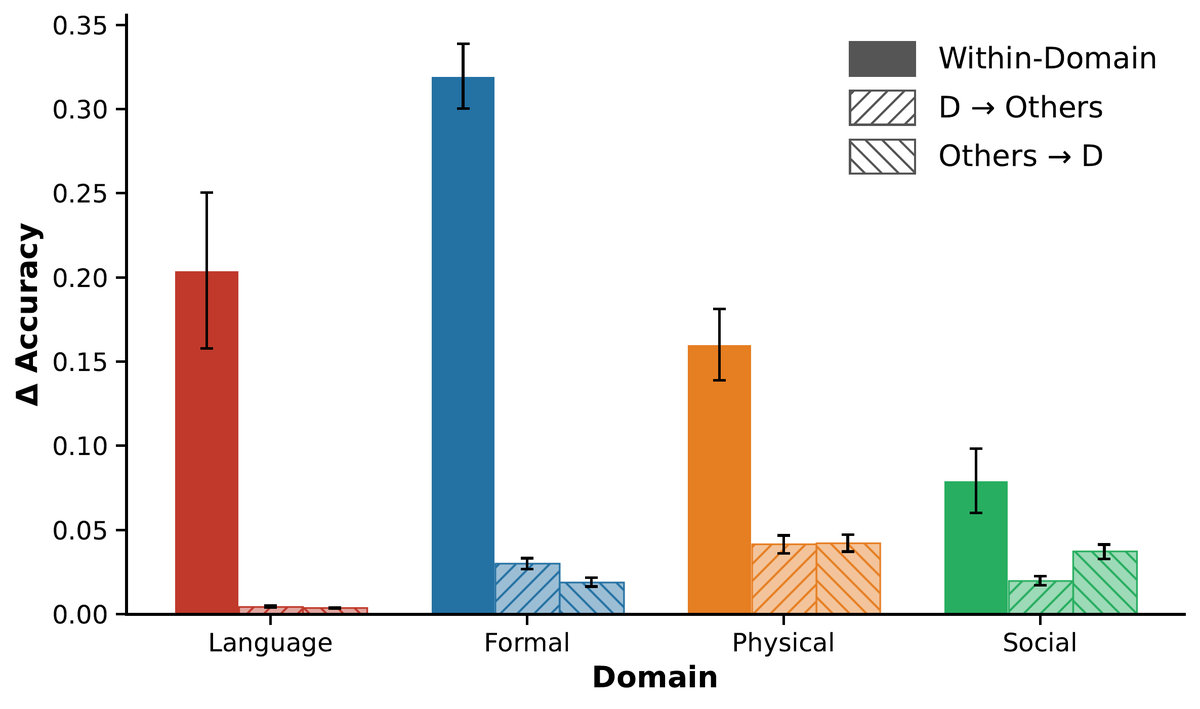
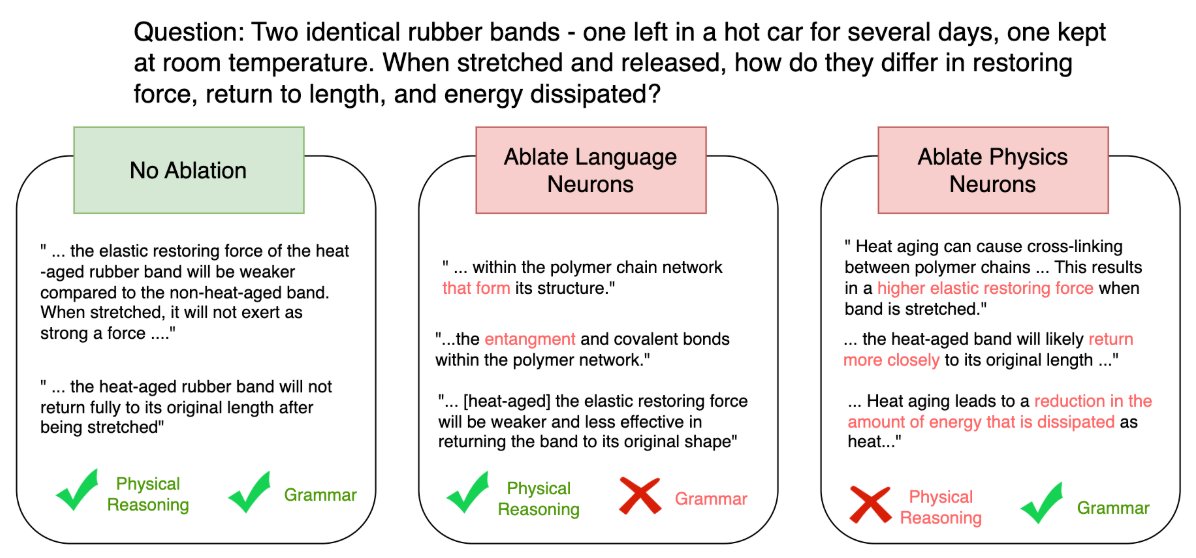
6/n These neurons also have domain-specific causal contributions. In targeted ablation experiments, we show that lesioning the neurons identified in one domain selectively impairs performance in other tasks from the same domain compared to tasks in other domains (a ten-fold https
 1.1K views · 18 likes
· 2 reposts · 0 replies
Open on X →
4/n To find the units to support these tasks, we use attribution patching. The analysis runs in four steps. (1) We start from each task's minimal pairs. (2) We pass both inputs through the model and record activations at every neuron. (3) We then score each neuron, combining how
 1.6K views · 26 likes
· 2 reposts · 0 replies
Open on X →
3/n Each task is built from minimal pairs. An "original" and an "alternative" input differ in a single task-relevant detail (e.g., 86 + 15 vs 86 + 16) but flip the correct answer (101 vs 102). This isolates the specific computation each task depends on. https://t.co/hYMwUGmjdG
 2.1K views · 32 likes
· 2 reposts · 0 replies
Open on X →
2/n We tested 46 tasks across four domains, grounded in brain networks studied in humans: language (supported by the language network), formal reasoning (Multiple-Demand network), physical reasoning (Intuitive Physics network), and social reasoning (Theory of Mind network). http
 3.3K views · 53 likes
· 4 reposts · 0 replies
Open on X →
The human brain is strikingly modular, with distinct networks for language, formal reasoning, social reasoning, and physical reasoning. Is this a fundamental principle of how intelligent systems are built, or an accident of biological evolution?
In our latest preprint, we find h
227.4K views · 2.3K likes
· 427 reposts · 48 replies
Open on X →
0:28
Growth & engagement
How the posts we collected actually performed: views and reaction rate post by post, what the audience did with them, and where the follower count goes.
Views per post
227.4K30 Jun
3.3K
2.1K
1.6K
1.1K
1K
631
Last 7 collected posts, oldest on the left. The scale is logarithmic: one post can outrun the rest a hundred times over.
Engagement rate per post
1.25%30 Jun
1.75%
1.60%
1.75%
1.89%
2.86%
1.74%
Reactions — likes, reposts, replies and quotes — divided by views.
What the audience does
Likes47.3%2 496 in total
Reposts8.3%439 in total
Replies1.0%51 in total
Quotes0.7%37 in total
Bookmarks42.7%2 252 in total
Share of every reaction we collected for this account. Replies mean argument, reposts mean endorsement, bookmarks mean the post was worth keeping.
The follower curve appears once this account has two daily snapshots — we take one a day, and this one is on its first.
Cuentas similares
 Russ Hepler ✓
@hepler10112
1.9K followers
· 142.4K posts
 Trading Hunters | Trading Community ✓
@trading_hunters
1.9K followers
· 2.2K posts
 FUNXUAL ✂️ ✂️
@funxual
1.9K followers
· 17.2K posts
 arrMY ✓
@ARRMYgg
1.9K followers
· 2.6K posts
 Nathanaël Benedict Pignalet 🇨🇵 🐘👑
@NBPignalet
1.9K followers
· 26K posts
 brxncco
@broncco2043
1.9K followers
· 17.5K posts
 MUFC
@oleole1999
1.9K followers
· 9.9K posts
 زين
@CRUELCRUEL222
1.9K followers
· 30.8K posts