tweetindex
FR

NASA Science ✓

@NASAScience_ · joined 10 Sep 2010

Powered by data, driven by discovery, made for everyone.

1 328 335Followers
84Following
20 705Posts total
818.3KViews on collected posts

Derniers posts

Want to put PACE land data to work in your research? Join us today at 1pm ET to access and explore PACE land products with AppEEARS. Follow a demonstration of tools for extracting observations, visualizing data, and plotting spectra. https://t.co/Hi6TfLABIe https://t.co/sJO7pC
Satellite imagery showing land vegetation data, captured by PACE.
11K views · 72 likes · 12 reposts · 1 replies Open on X →
Here’s your pick-me-up from the universe. 💫 Explore this week's Astronomy Picture of the Day images, each paired with a brief explanation from a professional astronomer: https://t.co/4J9RZ3VqVH https://t.co/KVvWlwBeVF
A colorful view of a glowing nebula shaped by flowing, cloud‑like gas. Bright orange and yellow filaments form a sweeping structure surrounded by a dense field of blue‑white stars. The background shifts from red to green hues, with star diffraction spikes scattered throughout the scene. Credit: ESA/Webb, NASA & CSA, M. Reiter; Acknowledgement: M. H. Özsaraç
41.5K views · 1.2K likes · 174 reposts · 22 replies Open on X →
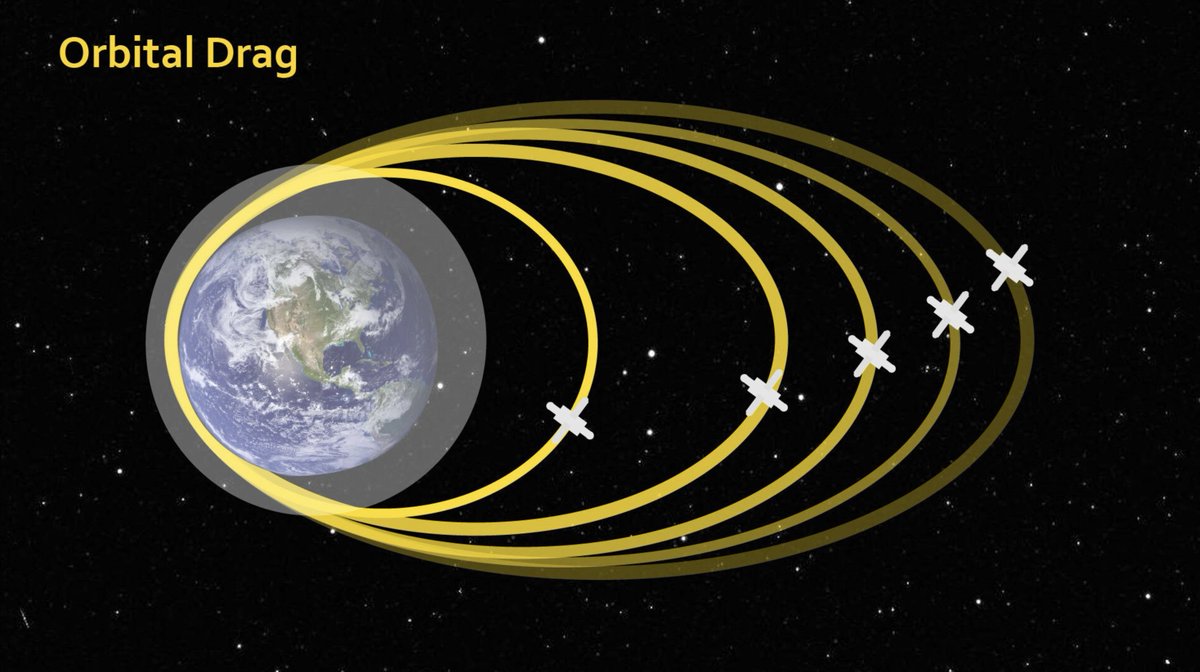
Space weather puffs up Earth's upper atmosphere, and that extra drag can shove satellites off course. NASA wants your ideas on low-cost, scalable ways to measure it. The prize is up to $500,000 per team plus a free ride to orbit! 🛰️ Info session on Sept. 22 at 1pm ET: https://t.
A diagram shows a satellite orbiting Earth, with each orbit getting closer due to orbital drag, illustrated by yellow curved paths decreasing in altitude against a starry background. “Orbital Drag” is labeled in yellow.
20.2K views · 397 likes · 66 reposts · 20 replies Open on X →
One Moon. One night. A world of people looking up. On Sept. 19, join International Observe the Moon Night by hosting your own observing event with friends, family or your community. 🔭 Register: https://t.co/skpd3Rk7BZ https://t.co/kFjwOzM8Ur
17.5K views · 196 likes · 43 reposts · 6 replies Open on X →
Imagine what we could discover when AI can tell a cosmic signal from an artifact. NASA’s new Artifact InSPECtor citizen science project invites you to help train AI to identify artifacts in data from @NASARoman and @esa's Euclid mission. 🔗 https://t.co/0xrj99bp6D https://t.co/
A detailed Hubble Space Telescope view of the face‑on spiral galaxy Messier 101 (the Pinwheel Galaxy). The bright core glows warm yellow, surrounded by sweeping spiral arms filled with clusters of hot blue stars, star‑forming nebulae, and intricate lanes of dust. The galaxy’s thin disk reveals countless stars and regions of glowing gas set against a dark backdrop dotted with more distant galaxies.
29.9K views · 484 likes · 96 reposts · 19 replies Open on X →
Nature’s coronagraph. 🌙☀️ Here’s a throwback to the 2024 total solar eclipse, when scientists and citizen scientists used this unique opportunity to collect observations of the innermost corona, helping researchers study how heat and energy move through the solar atmosphere. htt
A near‑total solar eclipse with the Moon covering most of the Sun. A bright burst of sunlight, known as the “diamond ring” effect, appears on the lower right edge. Soft rays extend outward, and several small, pink solar prominences are visible around the rim of the Sun.
40.7K views · 489 likes · 73 reposts · 16 replies Open on X →
What if we could explore the Moon with AI? Meet the @NASA–@IBM Lunar Foundation Model, a new open‑source AI trained on 17 years of lunar data to map craters, identify geologic features, and even help predict where ice may hide in the Moon’s darkest regions. 🌙 https://t.co/bMWlw
GIF
42.3K views · 428 likes · 89 reposts · 20 replies Open on X →
A meandering career path to the outer reaches of the solar system. 🪐 From terrestrial animals to microgravity experiments and Martian clouds, NASA program scientist Delia Santiago-Materese’s path has taken her through a surprising range of science. Now, she supports Dragonfly,
A person standing outdoors in a wooded area, smiling at the camera while holding a large model of Jupiter with brown and cream-colored bands. They wear a light gray cardigan, a pale shirt, and dark pants. Bare trees fill the background on an overcast day.
23.3K views · 149 likes · 20 reposts · 7 replies Open on X →
Now that @NASARoman has launched, it’s on its way to beginning its science mission: surveying billions of galaxies, discovering new worlds, and helping scientists investigate mysteries like dark matter and dark energy. Hear from Roman Project Scientist Julie McEnery. https://t.
4:56
38.9K views · 626 likes · 103 reposts · 24 replies Open on X →
What if you could work with NASA Earth science data without downloading entire datasets first? 🌎💻 Watch our webinar recording to learn how the earthaccess Python library can stream data directly into your Python workflow: https://t.co/u4juMcACsm https://t.co/lbnIExJluI
GIF
29K views · 377 likes · 78 reposts · 16 replies Open on X →
As @NASARoman begins mapping billions of galaxies to track our universe’s expansion, you can join the investigation today. Join NASA’s Dark Energy Explorers to help identify ancient galaxies using real telescope data: https://t.co/ptaJ0Fr3cJ https://t.co/wrNzPKt08Y
A composite astronomical image of Abell 2744, also called Pandora’s Cluster, showing a chaotic collision of multiple galaxy clusters. The background is filled with countless small, bright galaxies scattered across space. Overlaid colors highlight different data: red regions mark extremely hot gas detected by NASA’s Chandra X-ray Observatory, while blue areas show the distribution of mass—mostly dark matter—mapped using observations from NASA’s Hubble Space Telescope, the Very Large Telescope, and the Subaru telescope. The optical data reveal the individual galaxies belonging to the interacting clusters. Astronomers estimate that at least four galaxy clusters are merging from several directions. Credit: NASA, ESA, J. Merten (Institute for Theoretical Astrophysics, Heidelberg/Astronomical Observatory of Bologna), and D. Coe (STScI).
35.8K views · 1K likes · 182 reposts · 35 replies Open on X →
Bring a bit of the cosmos into your space @NASARoman is set to investigate some of the biggest questions in astrophysics, from how the universe evolved to how common planets are beyond our solar system. Celebrate its upcoming launch by bringing Roman into your own space: http
Stylized poster featuring the Nancy Grace Roman Space Telescope emerging from an open book, as if rising from its pages. The telescope is centered against a deep blue cosmic background with vertical beams of glowing light and swirling orbital paths encircling it. Small spacecraft and nebula-like elements float around the telescope, giving a sense of motion and discovery. At the top left is the NASA logo and “National Aeronautics and Space Administration.” At the bottom, bold text reads: “Nancy Grace Roman Space Telescope,” with “nasa.gov” in small type underneath.
39.1K views · 830 likes · 166 reposts · 19 replies Open on X →
NASA will host a Science Briefing today at 9:00 a.m. EDT to discuss the Roman Space Telescope mission followed by a Prelaunch News Conference at 10:30 a.m. EDT to discuss tomorrow morning's launch! 35K views · 236 likes · 46 reposts · 6 replies Open on X →
T-24 Hours! Roman is slated to liftoff tomorrow at 7:26 a.m. EDT! NASA will host a Science Briefing today at 9:00 a.m. EDT to discuss the Roman Space Telescope mission followed by a Prelaunch News Conference at 10:30 a.m. EDT to discuss tomorrow morning's launch! https://t.co/AS
0:14
101.6K views · 1.1K likes · 218 reposts · 21 replies Open on X →
Every discovery begins with light. Explore @NASARoman before launch to see how it will capture light, turn it into data, and send its observations back to Earth from about a million miles away. Explore the spacecraft: https://t.co/dLekuwXszE https://t.co/4XVB2erxSA
0:45
38.4K views · 626 likes · 106 reposts · 14 replies Open on X →
@NASAScience_ @NASARoman Roman’s strength is surveying huge areas quickly. Hubble excels at extraordinarily detailed observations of relatively small patches of sky; Roman is designed to bring similar sharpness to much larger celestial landscapes. 58 views · 2 likes · 0 reposts · 0 replies Open on X →
A typical 1980s video game screen had ~61,000 pixels. @NASARoman will capture 300 million. That’s nearly 5,000× more detail, giving scientists an unprecedented view of the universe. https://t.co/fmPUbPP6ab
GIF
41.3K views · 367 likes · 76 reposts · 10 replies Open on X →
@NASARoman Get a taste of Roman’s view with the Roman Space Observer game! Play Now🕹️: https://t.co/6bPAZOjBKA https://t.co/rtgkWGeMgh 3.1K views · 17 likes · 2 reposts · 2 replies Open on X →
@ISS_Research @Space_Station Great video and thanks to ARISS Telebridge station IK1SLD and the team for their excellent work in this very complex contact! https://t.co/JxQDyZkghQ 1.3K views · 14 likes · 2 reposts · 0 replies Open on X →
Keeping an eye on Earth! 🌎 Students from the Caribbean and Central America had the opportunity to learn about natural disaster research and monitoring, as seen from the unique perspective of the @Space_Station. https://t.co/EUOdBFjRxx
4:14
228.3K views · 488 likes · 56 reposts · 11 replies Open on X →

Face aux comptes de taille comparable

18 posts des 90 derniers jours, à côté de la tranche de 1M–10M abonnés. diffusé bien au-delà de son propre public, et ce public réagit.

Vues médianes35 408ce compte14 648médiane pour 1M–10M
Portée, %2.67%ce compte0.74%médiane pour 1M–10M
Engagement, %1.53%ce compte0.70%médiane pour 1M–10M
IndicateurCe compteMédiane pour 1M–10MRapport
Vues médianes par post35 40814 6482.42×
Portée (vues ÷ abonnés)2.67%0.74%3.60×
Taux d'engagement1.53%0.70%2.20×

Autres comptes de cette tranche →   Comparer avec un autre compte →   Comment ces repères sont établis →

Growth & engagement

How the posts we collected actually performed: views and reaction rate post by post, what the audience did with them, and where the follower count goes.

Views per post

101.6K29 Aug
35K
39.1K
35.8K31 Aug
29K8 Sep
38.9K9 Sep
23.3K
42.3K10 Sep
40.7K14 Sep
29.9K15 Sep
17.5K16 Sep
20.2K18 Sep
41.5K21 Sep
11K23 Sep

Last 14 collected posts, oldest on the left. The scale is logarithmic: one post can outrun the rest a hundred times over.

Engagement rate per post

1.36%29 Aug
0.83%
2.61%
3.45%31 Aug
1.63%8 Sep
1.96%9 Sep
0.76%
1.29%10 Sep
1.42%14 Sep
2.02%15 Sep
1.43%16 Sep
2.41%18 Sep
3.44%21 Sep
0.77%23 Sep

Reactions — likes, reposts, replies and quotes — divided by views. Median for 1M–10M accounts is 0.70%.

What the audience does

Likes76.3%9 142 in total
Reposts13.4%1 608 in total
Replies2.2%269 in total
Quotes1.0%121 in total
Bookmarks7.0%839 in total

Share of every reaction we collected for this account. Replies mean argument, reposts mean endorsement, bookmarks mean the post was worth keeping.

The follower curve appears once this account has two daily snapshots — we take one a day, and this one is on its first.

Comptes similaires