tweetindex
IT

Bravos Research

@bravosresearch · joined 22 Mar 2020

Data-driven Investment Research | Follow to learn about markets & global economy | Get swing trade ideas & market analysis at https://t.co/s4iOZprKNo

298 002Followers
643Following
20 791Posts total
359.9KViews on collected posts

Ultimi post

@bravosresearch Trump will distibute another Trillion if elected :) 5000 USD per adult x 200 million adults USA 1.1K views · 10 likes · 0 reposts · 1 replies Open on X →
26/ Thanks for reading! If you enjoyed this thread, please ❤️ and 🔁 the first tweet below And follow @bravosresearch for more market insights, finance and investment strategies https://t.co/9MQ3Xv39XD 5.2K views · 19 likes · 0 reposts · 2 replies Open on X →
25/ The Fed's Treasury purchases are now showing up in its balance sheet, which has started expanding again in recent months. More importantly, the Fed projects its balance sheet will expand even faster and continue growing through at least 2033. As bond vigilantes push https:/
3.6K views · 17 likes · 1 reposts · 3 replies Open on X →
24/ Hypothetically, a 1% rise in long-term rates could pull this crossover forward to late 2027 or early 2028. That's only 12–18 months away from now, which helps explain why the US Treasury is already preparing. The Fed has already started buying short term US government bonds
977 views · 6 likes · 0 reposts · 1 replies Open on X →
23/ Now the US nominal GDP growth is currently at 5.2%, but the demographic trends could slow it to 3.8% by 2030. At that point, economic growth would match the average interest rate of 3.8% the government pays on its debt. But these projections assume long-term interest rates
644 views · 13 likes · 0 reposts · 1 replies Open on X →
22/ Now a real problem occurs when the average interest rate on government debt exceeds economic growth. This is essentially the moment when a government's budget is completely squeezed. This is known as the R-G rule, and when it turns -ve, the debt-to-GDP ratio can rise https:
640 views · 10 likes · 0 reposts · 1 replies Open on X →
21/ This is something the "grow our way out” argument may not fully account for. But the bond vigilantes recognize the same problem very well, and are effectively demanding higher compensation for holding US debt. Policymakers like Trump and Scott Bessant will eventually have h
673 views · 9 likes · 0 reposts · 1 replies Open on X →
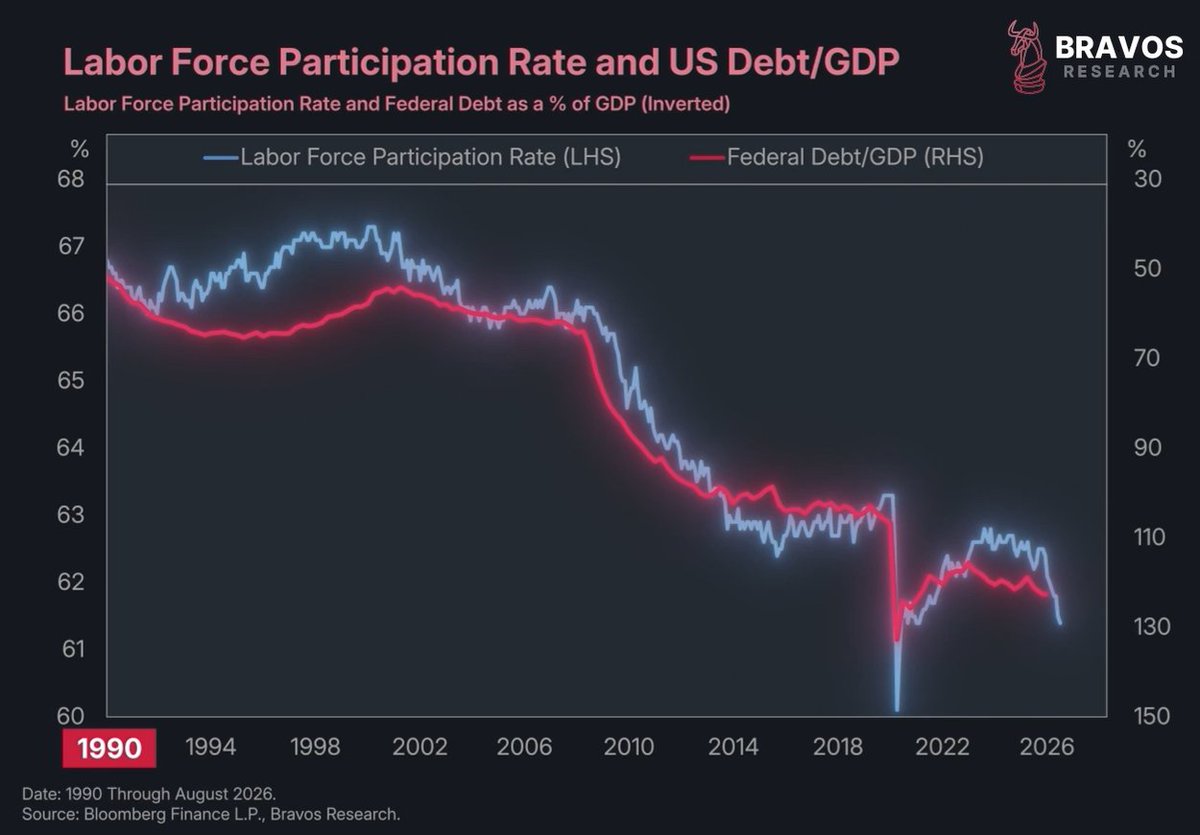
20/ Now, the US birth rate shifted forward 15 years has accurately predicted labor force participation for the past 20 years. The relationship is simple, when less babies are born, it means that less people are going to be working 15 years later. Based on this relationship, the
684 views · 8 likes · 0 reposts · 1 replies Open on X →
19/ When labor force participation falls, fewer people are working which reduces the taxable income and overall economic output. At the same time more people may rely on government programs, increasing spending. The government therefore has to borrow more as the economy slows.
709 views · 8 likes · 0 reposts · 1 replies Open on X →
18/ In theory, a country can grow its way out of a debt problem if the right conditions exist. But the data suggests that path is becoming increasingly difficult for the US. Because of the labor force participation rate, the share of working-age Americans employed or actively h
715 views · 9 likes · 0 reposts · 1 replies Open on X →
17/ Policymakers today suggest that if the economy grows fast enough to outpace government spending, the US debt can become manageable. President Trump himself has mentioned he believes that this is the best solution here. And US Treasury Secretary Scott Besant emphasized this
736 views · 9 likes · 0 reposts · 1 replies Open on X →
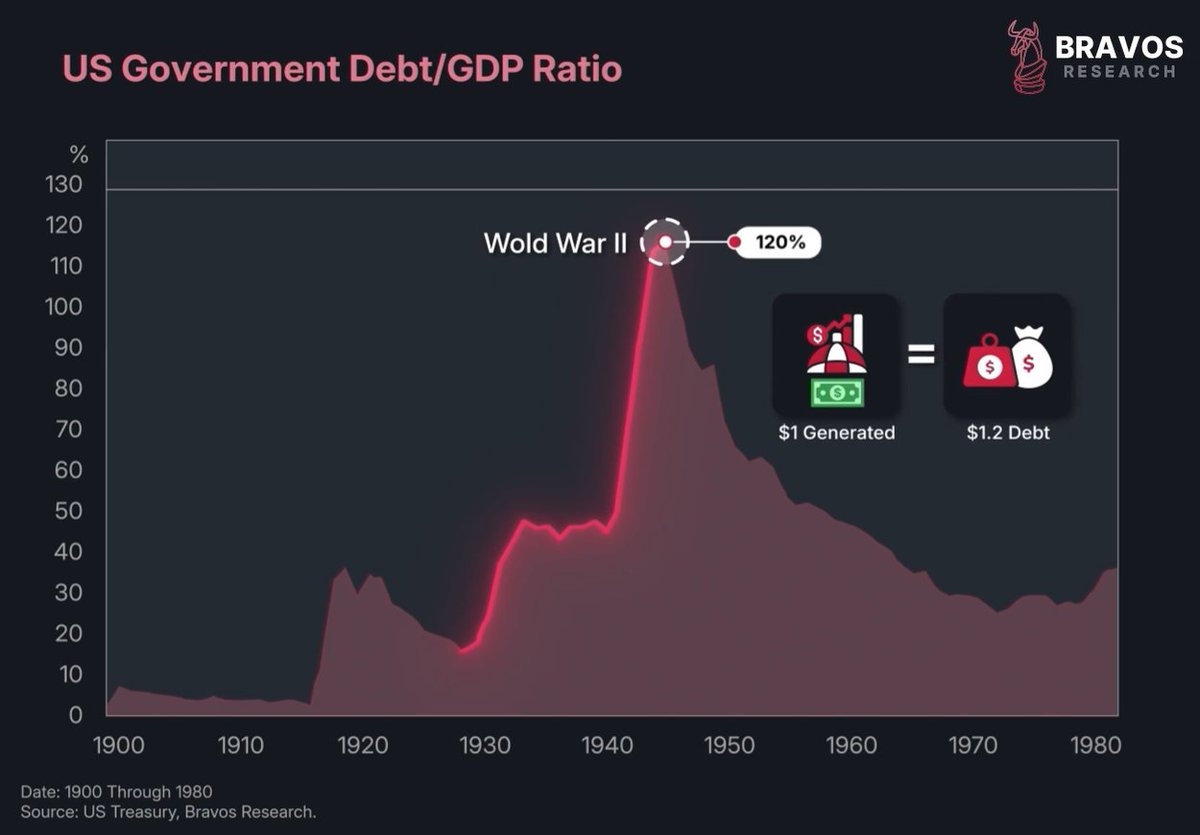
16/ But all of this money printing by the Fed came at a devastating cost for ordinary Americans. It caused inflation to jump from around 10% in 1941 all the way to 20% by 1947. The purchasing power of Americans' savings was effectively cut in ½ during that period. Today, US ht
736 views · 12 likes · 1 reposts · 1 replies Open on X →
14/ You see, the Fed controls the supply of US dollars, it has enormous capacity to create money and buy government bonds. This policy is known as financial repression. It artificially suppresses long-term yields to prevent interest payments from overwhelming the government's h
783 views · 8 likes · 1 reposts · 1 replies Open on X →
15/ Back then allowing bond yields to rise freely would have placed enormous pressure on the government's budget. So in April 1942, the Fed promised to buy unlimited amounts of US government bonds to keep yields below specific levels. Short-term rates were locked at 0.375%, and
765 views · 10 likes · 1 reposts · 1 replies Open on X →
13/ In 1977, through the Federal Reserve Reform Act, the Fed was given a 3rd mandate by the US government. This mandate is to moderate long-term interest rates. That means when long-term rates rise enough to threaten government stability, the Fed has the authority to intervene.
836 views · 8 likes · 0 reposts · 1 replies Open on X →
12/ Now the Treasury department is already attempting to intervene in the bond market to counter rising yields. So far, those interventions haven't been successful, but their size and frequency could increase as the government tries to regain control. The bigger question is htt
873 views · 7 likes · 0 reposts · 1 replies Open on X →
11/ If bond vigilantes continue pushing long-term interest rates higher, the government's interest burden will keep rising. That could put enormous pressure on the US budget, especially if interest payments eventually approach 50% of government spending. At that point, there ht
888 views · 14 likes · 1 reposts · 1 replies Open on X →
10/ We're seeing the consequences of this already beginning to show up. Today, the US government spends a record 20% of its tax revenue paying interest on its debt. In 2020, that figure was only 11%. The last time debt-service costs reached similar levels was in the late 1970s
932 views · 19 likes · 1 reposts · 1 replies Open on X →
9/ The term premium is the extra compensation investors demand for lending to the government for the long-term. This is the compensation for risks like inflation, geopolitical uncertainty, and the potential for fiscal recklessness. Now the Fed has largely kept short-term rates
1K views · 12 likes · 0 reposts · 1 replies Open on X →
7/ Now this debt ceiling has been raised repeatedly because the US government cannot abruptly stop spending. That means the supposed legal limit has little credibility and has almost no influence over actual spending. Despite rapidly approaching the ceiling, President Trump has
1.1K views · 15 likes · 0 reposts · 1 replies Open on X →
8/ Scott Besant, the US Treasury Secretary himself said that the US has a spending problem. And this is exactly what the bond vigilantes are concerned about today. Now long-term rates like the 10-year and 30-year Treasury yields have 2 components - The 1st is the short-term ht
1.1K views · 10 likes · 0 reposts · 1 replies Open on X →
6/ Now on paper, the US government has a limit on how much debt it can actually borrow, called the debt ceiling. This is essentially the legal limit on how much the US government is allowed to borrow. And currently it sits at $41.1 trillion, slightly above where we are today. h
1.2K views · 14 likes · 1 reposts · 1 replies Open on X →
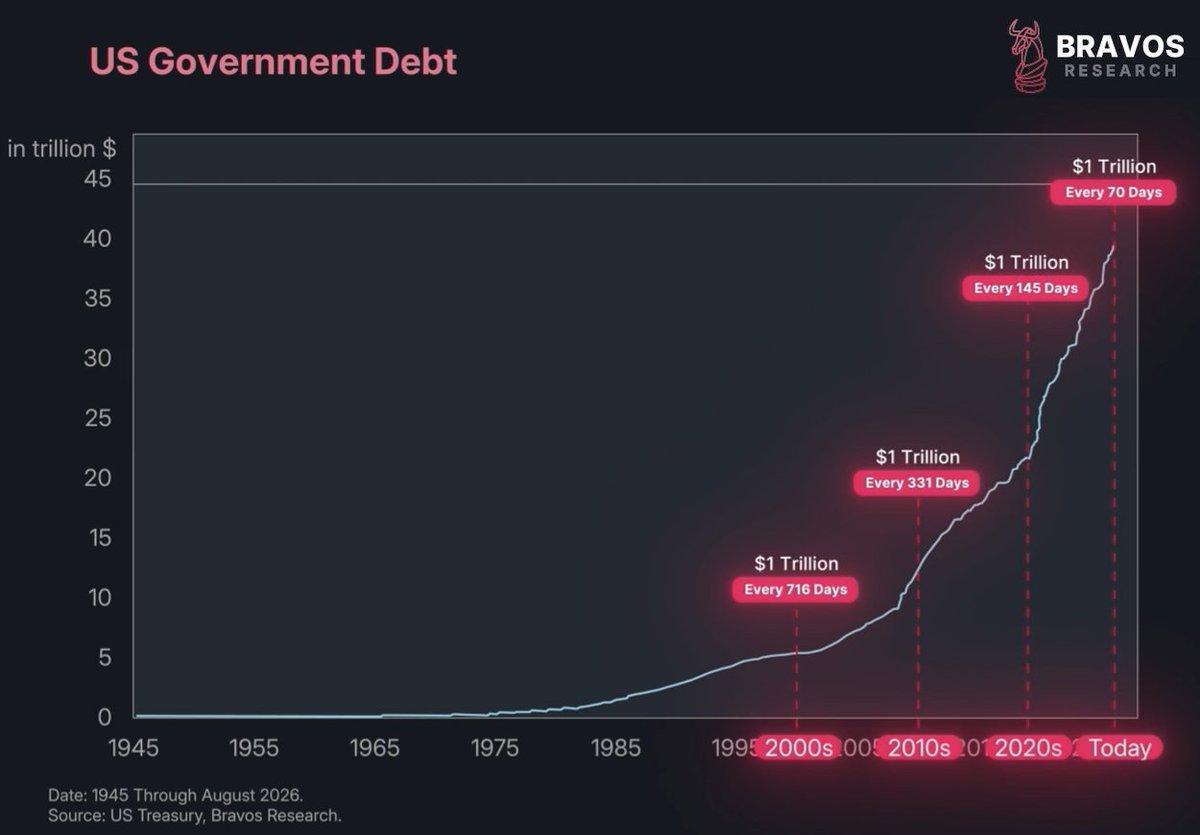
5/ The bond vigilantes control very large amounts of government debt. As a result they have significant influence over how much the US government pays to borrow. Now, the problem today is that the US government's debt load is surging rapidly, having just crossed $40 trillion. h
1.3K views · 21 likes · 0 reposts · 1 replies Open on X →
4/ So the bond market is signaling that the steps taken by the US Treasury are not enough. Now to understand what comes next, we need to look at the force pushing government bond yields higher - The Bond Vigilantes. These are large institutional investors, including pension htt
1.5K views · 12 likes · 0 reposts · 1 replies Open on X →
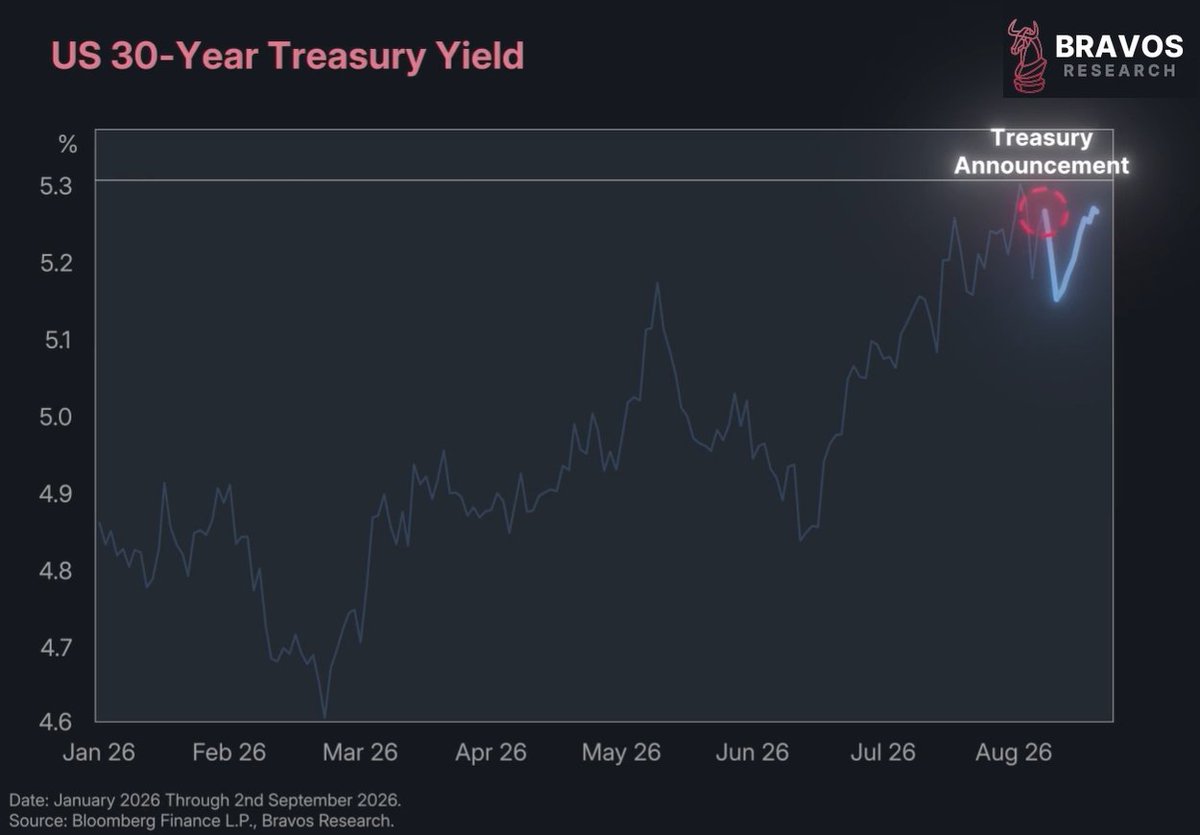
3/ The Treasury recently announced it would at least 2x its buyback program to ease the pressure on long-term yields. And this could have some major implications for the value of money and financial assets. Now on the day of this announcement government bond yields did come htt
1.9K views · 18 likes · 0 reposts · 1 replies Open on X →
2/ The US government recently borrowed money for 10 years at its highest rate since 2007. Their 30-year borrowing rate also exceeded 5%, the highest level since 2001. When long-term borrowing costs rise it puts enormous pressure on the government's finances. Right now, this ht
2.6K views · 30 likes · 2 reposts · 1 replies Open on X →
The US government once took 2 years to add $1 trillion in debt. Today, that same $1 trillion is added in just 10 weeks. America's debt problem is getting out of control. A thread 🧵 https://t.co/2wJs0k5y2P
80.4K views · 1.1K likes · 289 reposts · 42 replies Open on X →
@bravosresearch Thank goodness I am my own central bank. 702 views · 3 likes · 0 reposts · 0 replies Open on X →
26/ Thanks for reading! If you enjoyed this thread, please ❤️ and 🔁 the first tweet below And follow @bravosresearch for more market insights, finance and investment strategies https://t.co/J1cklCYJgU 7.2K views · 66 likes · 8 reposts · 4 replies Open on X →
25/ Now other countries might have a little choice but to adopt Yuan if: - Dollar collapses because of excessive spending by US Government - China anchors Yuan to physical gold That could allow China to reshape the global monetary system without going to war with the US. But h
5.2K views · 34 likes · 1 reposts · 2 replies Open on X →

Rispetto ad account della stessa dimensione

57 post degli ultimi 90 giorni, accanto alla fascia di 100K–1M follower. raggiunge meno persone di account della stessa dimensione.

Visualizzazioni mediane2 298questo account3 974mediana per 100K–1M
Copertura, %0.77%questo account1.54%mediana per 100K–1M
Interazione, %1.08%questo account1.32%mediana per 100K–1M
MetricaQuesto accountMediana per 100K–1MRapporto
Visualizzazioni mediane per post2 2983 9740.58×
Copertura (visualizzazioni ÷ follower)0.77%1.54%0.50×
Tasso di interazione1.08%1.32%0.82×

Altri account di questa fascia →   Confronta con un altro account →   Come sono costruiti questi parametri →

Growth & engagement

How the posts we collected actually performed: views and reaction rate post by post, what the audience did with them, and where the follower count goes.

Views per post

7659 Sep
783
736
736
715
709
684
673
640
644
977
3.6K
5.2K
1.1K10 Sep

Last 14 collected posts, oldest on the left. The scale is logarithmic: one post can outrun the rest a hundred times over.

Engagement rate per post

1.57%9 Sep
1.28%
1.90%
1.36%
1.40%
1.27%
1.32%
1.49%
1.72%
2.17%
0.72%
0.58%
0.40%
1.04%10 Sep

Reactions — likes, reposts, replies and quotes — divided by views. Median for 100K–1M accounts is 1.32%.

What the audience does

Likes70.2%1 526 in total
Reposts14.1%307 in total
Replies3.5%77 in total
Bookmarks12.1%263 in total

Share of every reaction we collected for this account. Replies mean argument, reposts mean endorsement, bookmarks mean the post was worth keeping.

The follower curve appears once this account has two daily snapshots — we take one a day, and this one is on its first.

Account simili