tweetindex
PT

Itai Yanai

@ItaiYanai · NYU, School of Medicine · joined 17 Jan 2015

Professor at the NYU School of Medicine. Co-host of the 'Night Science Podcast' @nightsciencepod and Co-founder of the Night Science Institute https://t.co/lede3rBmXU

34 755Followers
1 789Following
4 491Posts total
466.9KViews on collected posts

Posts recentes

PhD students: this is happening tomorrow so there is still time to sign up (already 90 participants registered!). 2.5K views · 10 likes · 2 reposts · 0 replies Open on X →
Do you think you would have discovered a gorilla hiding in plain sight in your data? In our 2020 paper, we found that you are 3 times less likely to find it if you have a specific hypothesis in mind. A hypothesis is a liability - always keep an eye out for the gorilla in the http
2.2K views · 23 likes · 4 reposts · 1 replies Open on X →
@ItaiYanai My personal experience is different. I always felt motivated to take risks, and my most recognized success is based upon taking risks. I recently talked about this experience: https://t.co/AbS3ZKV9MK 1.7K views · 14 likes · 1 reposts · 0 replies Open on X →
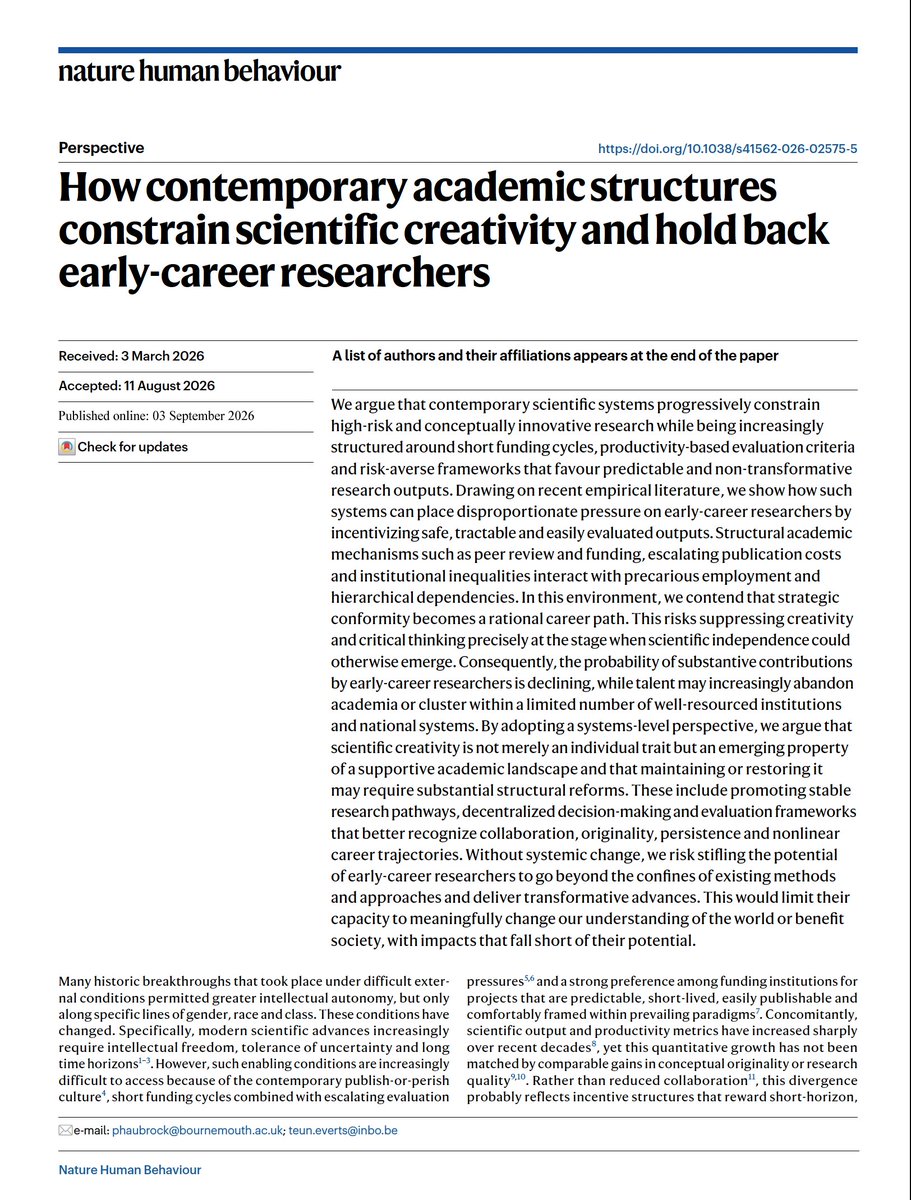
An important read by @HaubrockPhillip @TeunEverts and many others. https://t.co/OYNOi45hR6 2.7K views · 20 likes · 6 reposts · 0 replies Open on X →
🔥Does academia stifle creativity? This new perspective argues that academia is currently structured to select against creativity, intellectual risk-taking and bold ideas. Young scientists – who may be best positioned for new ideas – are particularly incentivized to play it safe.
107.8K views · 845 likes · 240 reposts · 47 replies Open on X →
Doing a PhD is - at heart - one long discussion with your mentor. The discussion changes over time - with unexpected turns and ups & downs - but through it all is two people discussing a topic endlessly to make sense of it. PhD students: choose someone you like to talk to. 54.1K views · 1.2K likes · 129 reposts · 8 replies Open on X →
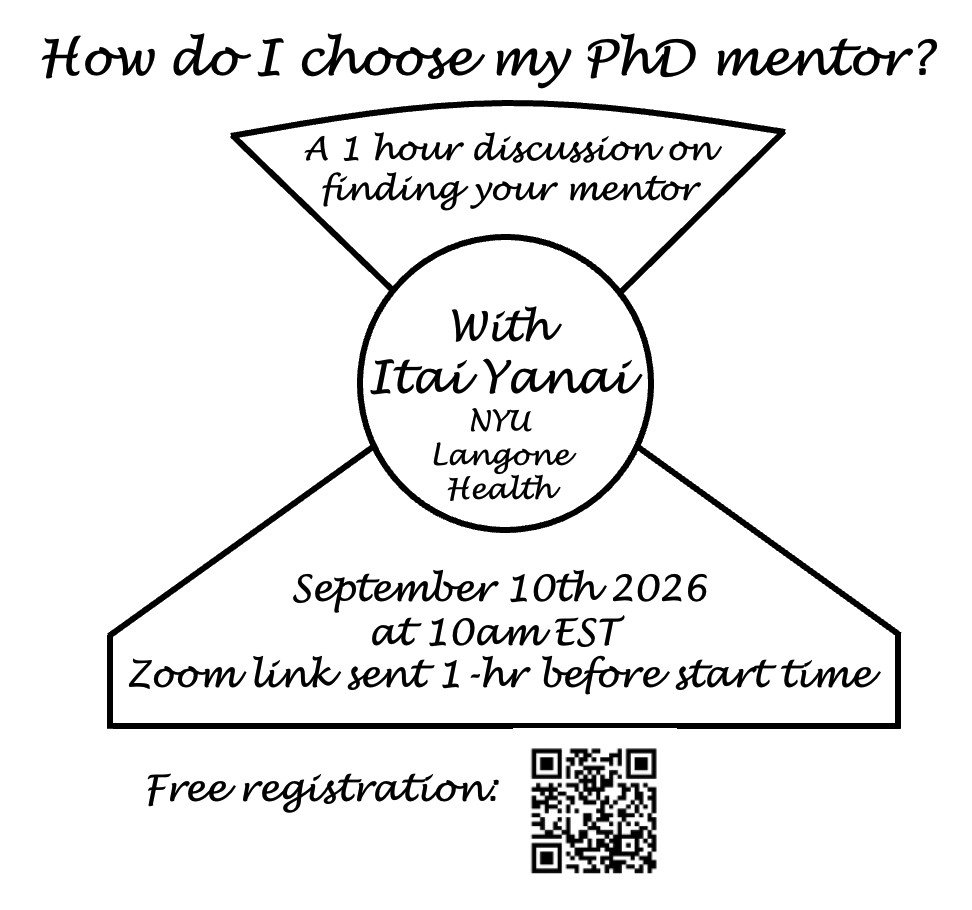
PhD students: interested in a discussion on how to choose your mentor? Join me on September 10th at 10am EST! Free registration: https://t.co/V27KSC9uYi https://t.co/sNWWxQgzbd
11.2K views · 38 likes · 9 reposts · 0 replies Open on X →
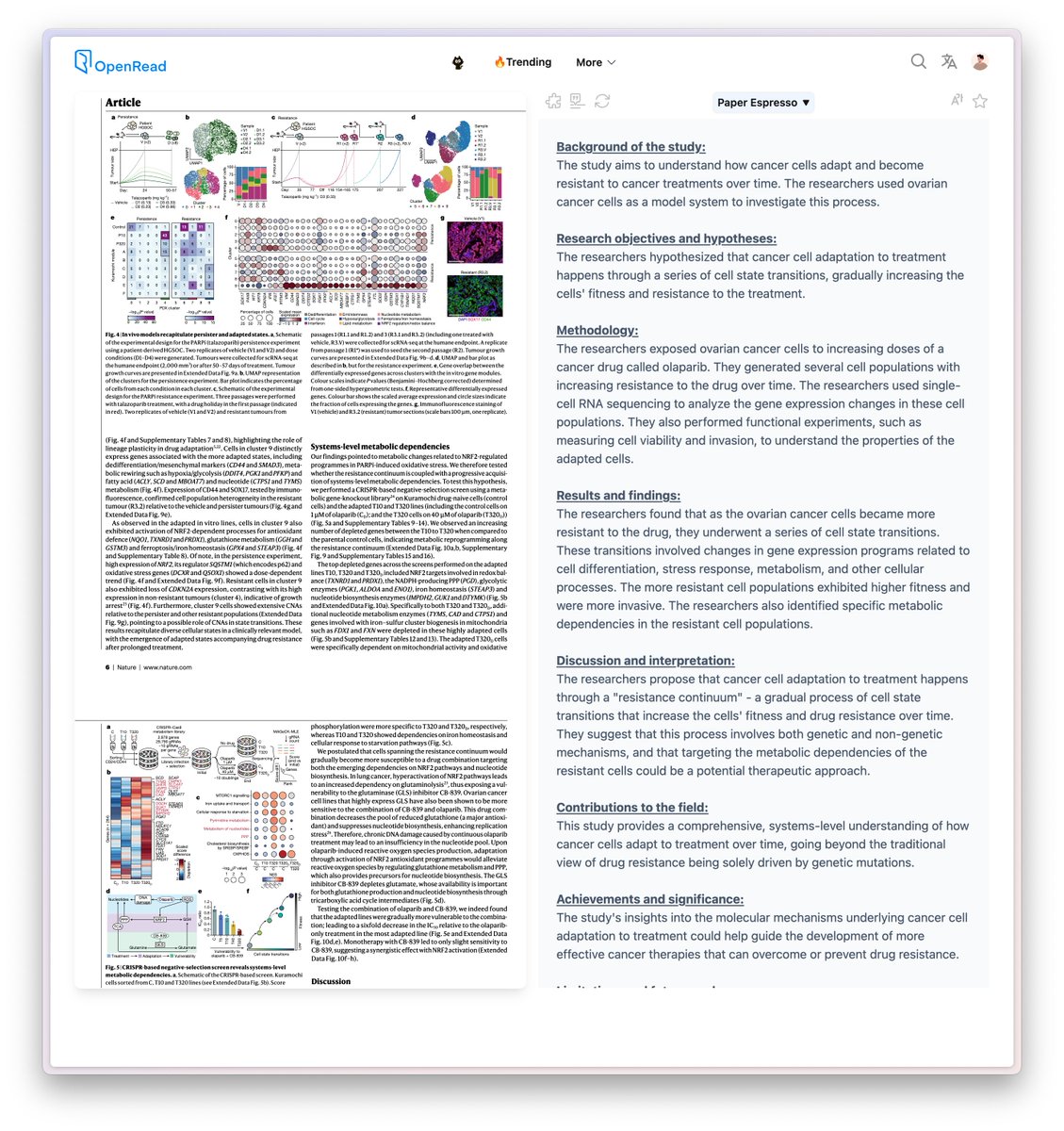
@ItaiYanai @Gustavo_SFranca The researchers found that as the ovarian cancer cells became more resistant to the drug, they underwent a series of cell state transitions. These transitions involved changes in gene expression programs related to cell differentiation, stress response
699 views · 6 likes · 1 reposts · 0 replies Open on X →
It really takes a village to do a project like this. Thank you for the amazing contributions of @maayan_baron, @MaayanPour, @anj_rao, @selimisirlioglu, @BarkleyDalia, @bioigor, @KwanTang5 , Marta Chiodin, Gal Avital, @FKuperwaser, @AyushiPatel3994, @debbie_liberman & @levinemd! 3.2K views · 13 likes · 0 reposts · 1 replies Open on X →
This paper is a testament to the amazing work of Gustavo S. França (@Gustavo_SFranca) who spearheaded this entire project! Gustavo is also on the job market now by the way 😉 https://t.co/IRQoWQAMsp
2.1K views · 25 likes · 0 reposts · 1 replies Open on X →
It was also a great collaboration with Tim Lionnet's lab @successprocess, in particular with Ben King, and with the labs of @ThalesPapaG and @AndriyMarusyk, with the dedicated work of Jozef Bossowski and Alicia Bjornberg. 3.4K views · 7 likes · 0 reposts · 1 replies Open on X →
We also performed a negative selection CRISPR screen using a metabolic gene knockout library to test whether the genes that are expressed in the resistant states are also required. In line with the adaptive modules, we found an increased dependency on nucleotide metabolism. https
3.9K views · 20 likes · 2 reposts · 1 replies Open on X →
Our study also highlights the need for careful dose optimization, treatment intervals and longitudinal monitoring aiming to prevent drug-induced adaptation. 1.9K views · 14 likes · 0 reposts · 1 replies Open on X →
These dynamics of cellular adaptation may have clinical implications in the sense that limited penetration of many drugs into solid tumors generates real-life drug gradients, thus possibly priming cells for adaptation. 2.8K views · 20 likes · 3 reposts · 1 replies Open on X →
To study this in vivo, we generated two mouse models for shorter (persistence) and longer term response (resistance). We found that the short-term treatment elicited a partial reprogramming while the resistance model revealed convergence with the in vitro adapted states. https://
2.2K views · 15 likes · 0 reposts · 1 replies Open on X →
Is this genetic? We found that copy number alterations are indeed associated with the states, but also that these are reinforced by epigenetically regulated stress response TFs (AP1, NRF2, ATF4) & the loss of cell identity in terms of closing sites associated with lineage markers
2.8K views · 30 likes · 4 reposts · 2 replies Open on X →
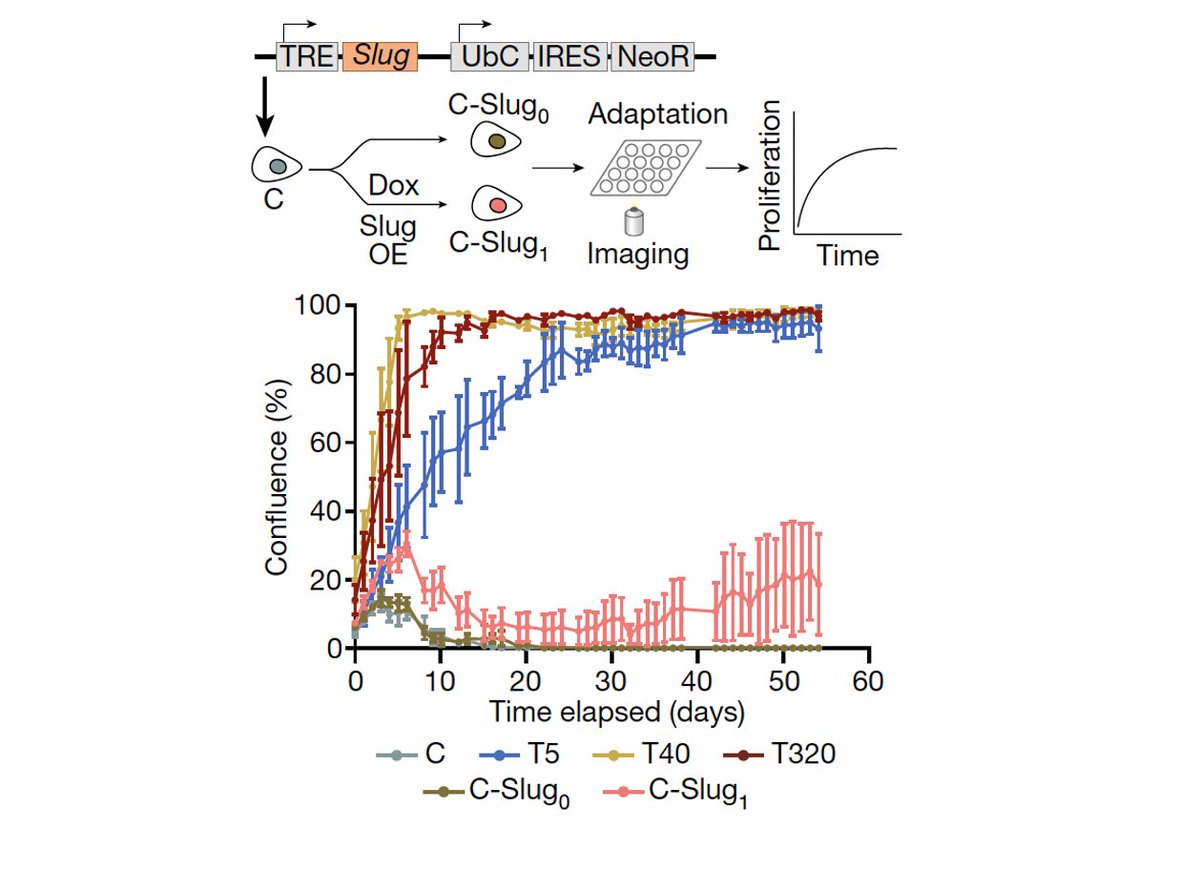
We also found that epithelial-to-mesenchymal transition (EMT) or stemness programs—often considered a proxy for phenotypic plasticity—enable adaptation, but are not a full resistance mechanism. We particularly thank @AndriyMarusyk & Alicia Bjornberg for working with us on this! h
2.4K views · 16 likes · 1 reposts · 3 replies Open on X →
Cellular adaptation occurs along a continuum driven by the emergence and selection of cellular states. You can see this better when looking at the frequency of cells in each of the five states across the adaptive lines. https://t.co/cbOhtQEVQ3
2.5K views · 17 likes · 0 reposts · 1 replies Open on X →
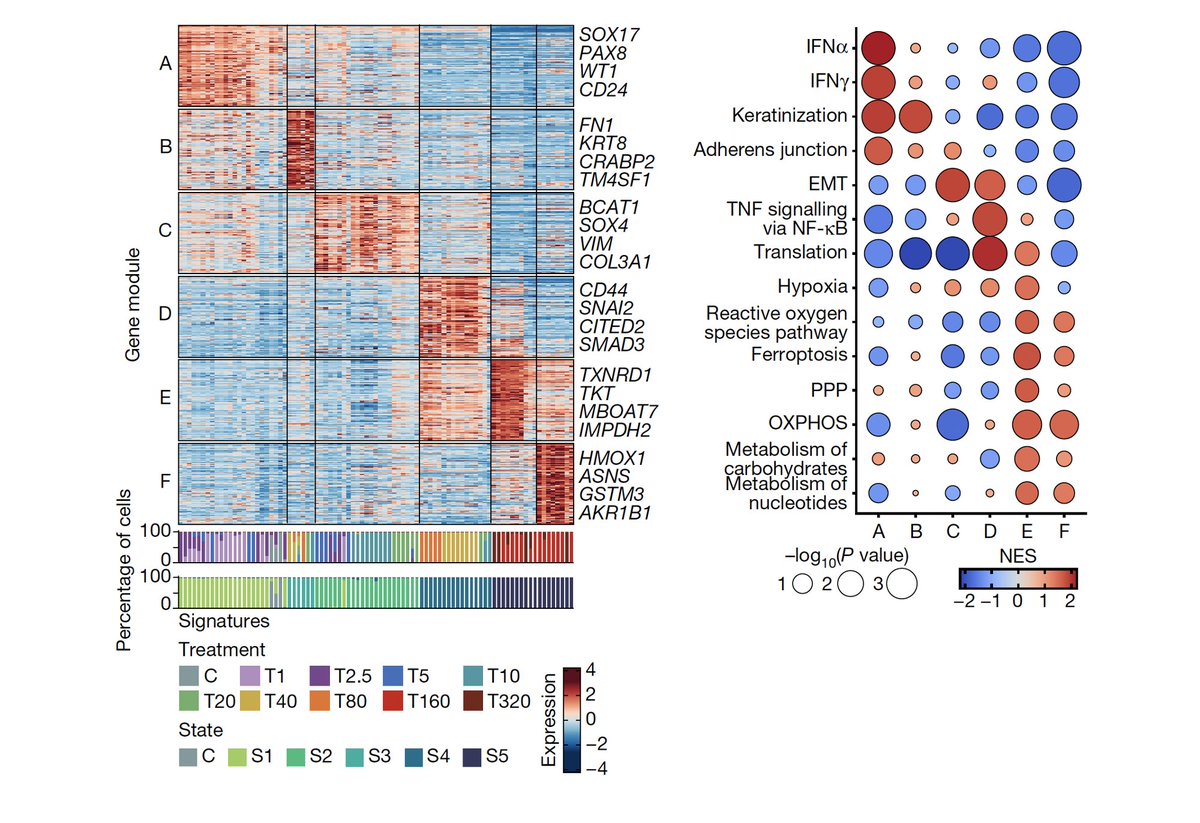
Using a gene module detection approach, we detected the gene expression modules that underlie the states. These gene modules each comprise distinct biological functions that may contribute to the survival of the drug resistant cells. https://t.co/td0HhEFQVA
2.4K views · 14 likes · 1 reposts · 1 replies Open on X →
Applying single-cell RNA-Seq, we found that as cancer cells become increasingly drug resistant, their gene expression programs evolved accordingly by the emergence of new transcriptional states, and multi-step state transitions among them. https://t.co/hM6f8jMHPW
2.7K views · 19 likes · 1 reposts · 2 replies Open on X →
Similarly to the MEGA-plate experiment, we found that previous drug exposure with lower doses facilitated the emergence of resistant populations to progressively higher doses. Thus, incremental adaptive responses unfolded along a continuum, and not a transition to full resistance
3.1K views · 25 likes · 1 reposts · 1 replies Open on X →
Our inspiration was the famous ‘MEGA-plate experiment’ by @baym, @conTaminatedsci @RoyKishony et al, in which bacteria were grown on a set of antibiotic concentrations. Exposure to low concentrations facilitated resistance to higher concentrations. https://t.co/S9otVb0gpE https:/
4.7K views · 44 likes · 3 reposts · 2 replies Open on X →
We imagined that an analogous process may be happening in cancer cells, and so we performed a dose-escalation experiment on ovarian cancer cells treated with a PARP inhibitor. Over the course of 12 months we generated a panel of 10 adapted populations. https://t.co/HKXvx6Wy8T
3.1K views · 24 likes · 2 reposts · 1 replies Open on X →
We found that cellular adaptation occurs by a series of cell state transitions, each with distinct gene expression programs and leading to increased resistance. This follows on the pioneering work of @sydshaffer, @arjunrajlab, @AndriyMarusyk, @lab_marine and others. https://t.co/
11.2K views · 58 likes · 7 reposts · 2 replies Open on X →
Published today! We found that cancer cells adapting to drug treatments don't simply switch from a sensitive to resistant state; instead there's a ‘resistance continuum’ of resistant phenotypes with epigenetically reprogrammed states. 🧵⬇️ https://t.co/Jgx79K3i3a @Gustavo_SFranca
229.6K views · 1.8K likes · 393 reposts · 32 replies Open on X →

Em comparação com contas do mesmo porte

7 posts dos últimos 90 dias, ao lado da faixa de 10K–100K seguidores. aparece para muita gente, mas poucos desses espectadores reagem.

Mediana de visualizações2 731esta conta1 084mediana para 10K–100K
Alcance, %7.86%esta conta3.91%mediana para 10K–100K
Engajamento, %0.95%esta conta1.69%mediana para 10K–100K
MétricaEsta contaMediana para 10K–100KProporção
Mediana de visualizações por post2 7311 0842.52×
Alcance (visualizações ÷ seguidores)7.86%3.91%2.01×
Taxa de engajamento0.95%1.69%0.56×

Outras contas desta faixa →   Comparar com outra conta →   Como estas referências são construídas →

Growth & engagement

How the posts we collected actually performed: views and reaction rate post by post, what the audience did with them, and where the follower count goes.

Views per post

2.8K10 Jul
1.9K
3.9K
3.4K
2.1K
3.2K
699
11.2K2 Sep
54.1K3 Sep
107.8K7 Sep
2.7K
1.7K
2.2K9 Sep
2.5K

Last 14 collected posts, oldest on the left. The scale is logarithmic: one post can outrun the rest a hundred times over.

Engagement rate per post

0.85%10 Jul
0.81%
0.59%
0.24%
1.23%
0.44%
1.00%
0.42%2 Sep
2.50%3 Sep
1.05%7 Sep
0.95%
0.87%
1.27%9 Sep
0.48%

Reactions — likes, reposts, replies and quotes — divided by views. Median for 10K–100K accounts is 1.69%.

What the audience does

Likes66.6%4 350 in total
Reposts12.4%810 in total
Replies1.7%110 in total
Bookmarks19.3%1 258 in total

Share of every reaction we collected for this account. Replies mean argument, reposts mean endorsement, bookmarks mean the post was worth keeping.

The follower curve appears once this account has two daily snapshots — we take one a day, and this one is on its first.

Contas semelhantes