tweetindex
RU

Douglas Yao

@DouglasYaoDY

Making drugs https://t.co/OpaKgZ2ZCe. Prev computational bio PhD @harvard

16 483Followers
401Following
431Posts total
10.4MViews on collected posts

Последние посты

@DouglasYaoDY > was designed by ChatGPT > chemistry lab I built in my garage hmm > treating schizophrenia ah. 76.1K views · 6.8K likes · 131 reposts · 17 replies Open on X →
@DouglasYaoDY Stop focusing on pointless things like schizophrenia and please lock in on Male Pattern Baldness 71.5K views · 3.7K likes · 53 reposts · 30 replies Open on X →
PAC-3310 is the second drug to come out of my AI-enabled home drug discovery lab, the first being PAC-832 for Alzheimer’s disease which I announced 2 months ago (https://t.co/IWzxYTg5fn). I heavily utilized frontier AI models and liquid-handling robotics to develop both drugs. 258K views · 1.2K likes · 38 reposts · 59 replies Open on X →
When administered to mice, PAC-3310 significantly reduces MK-801-induced hyperlocomotion, demonstrating that it has antipsychotic effects in vivo. Moreover, at doses up to 10x the effective dose, PAC-3310 produces none of the side effects typical of non-selective muscarinic http
1:00
280.9K views · 657 likes · 13 reposts · 27 replies Open on X →
Finally, PAC-3310 exhibits excellent pharmacokinetics (oral bioavailability > 70%, brain/plasma ratio > 0.5, plasma protein binding < 80%) and manufacturability. (6/7) https://t.co/ofGVaajykf
170.9K views · 479 likes · 7 reposts · 8 replies Open on X →
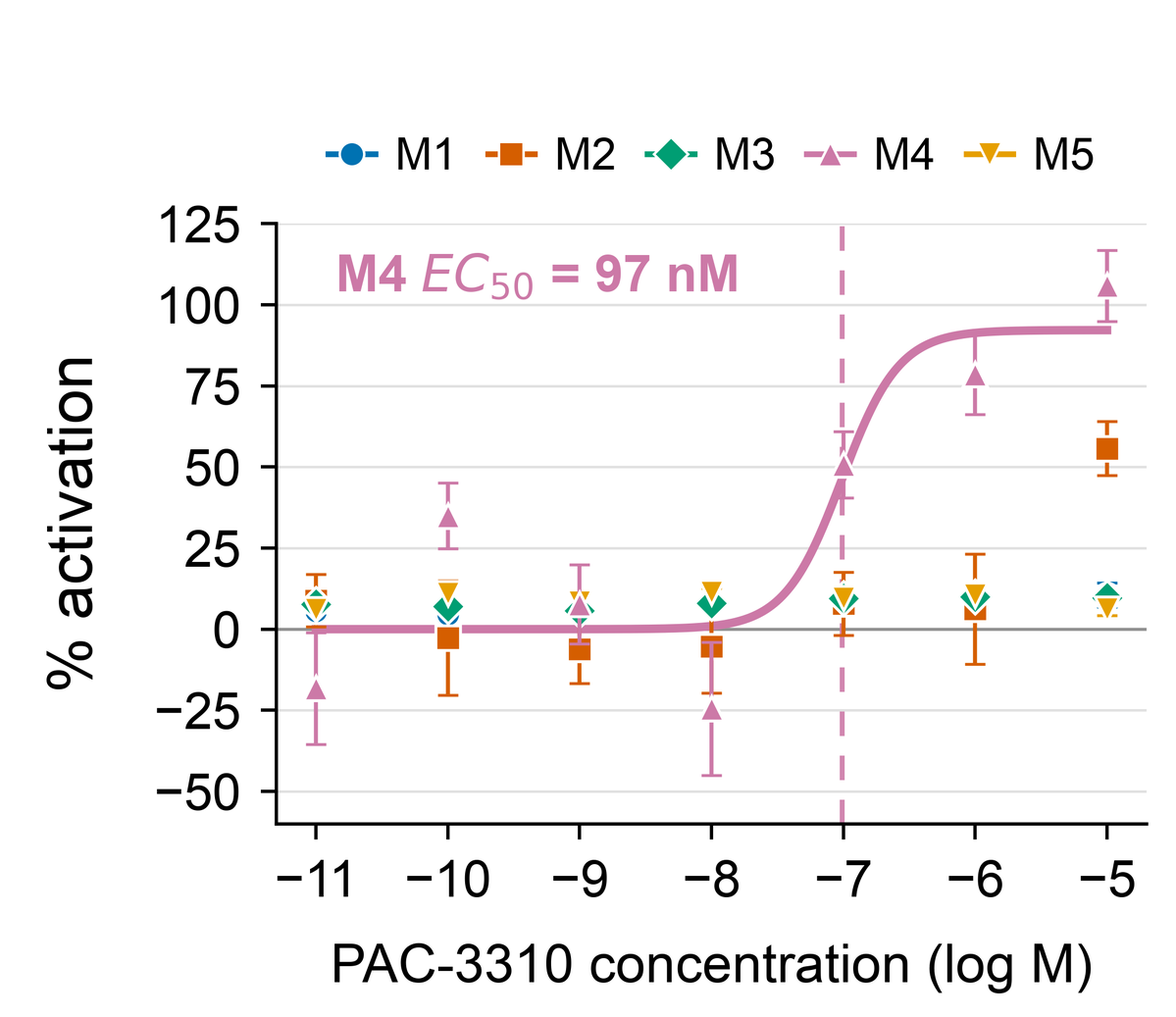
My new drug PAC-3310 improves on Cobenfry by exhibiting a much better selectivity profile across the five muscarinic receptors. In functional cell assays, PAC-3310 has nanomolar potency for M4 (EC50 = 97 nM) and >100x selectivity over M1, M2, M3, and M5 (EC50 > 10 uM for each). h
232.7K views · 573 likes · 11 reposts · 7 replies Open on X →
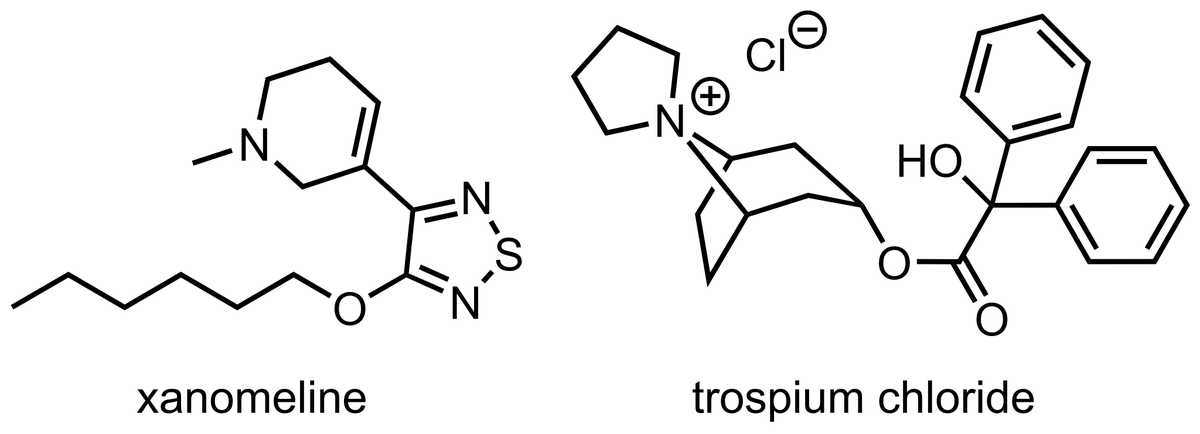
1 in 4 people with schizophrenia don’t respond to any existing drugs/treatments. In 2024, Cobenfry made waves by becoming the first FDA-approved schizophrenia drug with a totally new mechanism. Rather than blocking dopamine receptors like all previous schizophrenia drugs, it http
406.7K views · 943 likes · 20 reposts · 23 replies Open on X →
An alternative, more direct strategy that avoids the side effects of Cobenfry altogether is to design the muscarinic agonist to be ‘subtype-specific’ - that is, activate only M4, and not any of the other muscarinic receptors. This is exactly what PAC-3310 does. (3/7) 265.1K views · 581 likes · 7 reposts · 7 replies Open on X →
This vial contains a new drug called PAC-3310. It was designed by ChatGPT, and I synthesized it in a chemistry lab I built in my garage. PAC-3310 is a new selective M4 muscarinic receptor agonist for treating schizophrenia - similar to the recent breakthrough drug Cobenfry, but
6.1M views · 15.4K likes · 1.1K reposts · 890 replies Open on X →
@DouglasYaoDY @cremieuxrecueil Great job! 13.9K views · 380 likes · 2 reposts · 6 replies Open on X →
A final word: the development of PAC-832 was catalyzed by various modern technologies, most notably liquid-handling robotics and large language models / AI agents. All of the in vitro screening was performed by an OpenTrons OT-2 liquid-handling robot programmed by Claude Code. 54.7K views · 921 likes · 46 reposts · 37 replies Open on X →
My new drug, PAC-832, builds upon decades of progress from the galanin field and solves all the problems that caused previous galanin-targeting drugs to fail. Unlike Sch202596, PAC-832 has great manufacturability - it’s possible to synthesize large quantities of it in a garage 38.2K views · 313 likes · 2 reposts · 3 replies Open on X →
Following this strategy, the GalR3-selective small molecule antagonist HT-2157 was developed by Synaptic Pharmaceutical and entered clinical trials in 2011 for depression. However, the drug did not progress beyond Phase 1 due to safety issues. After that, interest in https://t.co
31.1K views · 155 likes · 1 reposts · 1 replies Open on X →
A viable path for a drug targeting galanin signaling emerged from these findings. Rather than blocking galanin activity across all contexts, one could in theory design an inhibitor that selectively blocks ONLY GalR1 and/or GalR3 (thus removing the brake on ACh release, and 31K views · 166 likes · 2 reposts · 1 replies Open on X →
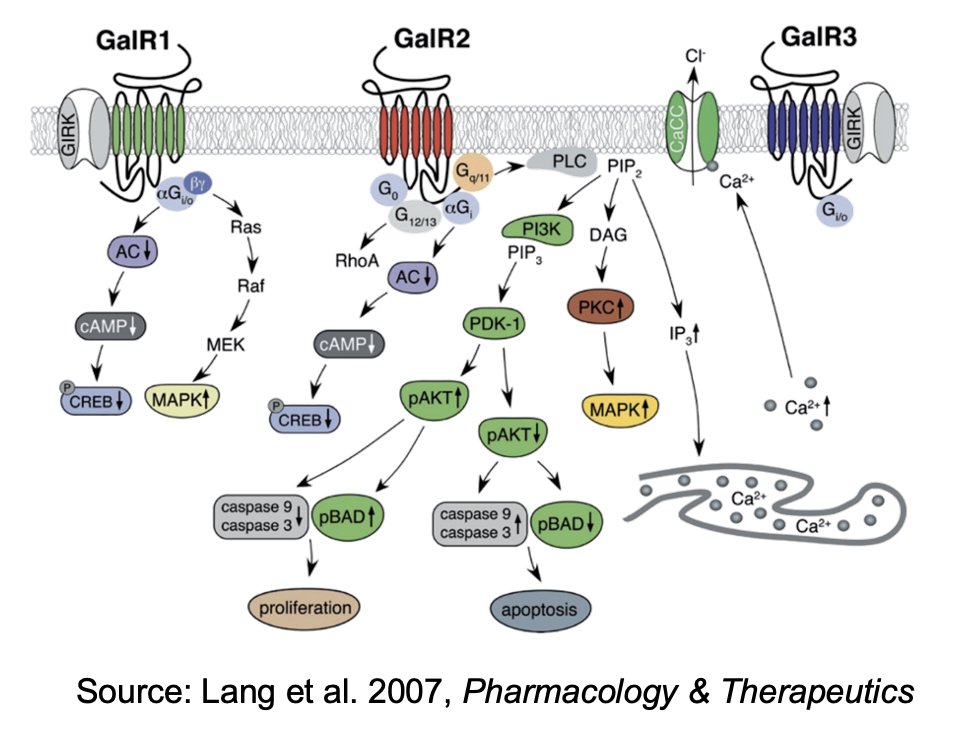
On the other hand, GalR2 was found to activate a different G-coupled pathway - the Gq/11 pathway, which broadly results in cell activation. Various studies found that the protective effects of galanin were downstream of this pathway and mediated through GalR2. (12/16) https://t.c
32.5K views · 163 likes · 1 reposts · 2 replies Open on X →
However, the seemingly contradictory harmful vs. protective effects of galanin were soon resolved by molecular research tied to the three galanin receptors, known as GalR1-3. The galanin receptors are part of a large family of receptors known as ‘G-protein coupled receptors,’ htt
35K views · 206 likes · 1 reposts · 1 replies Open on X →
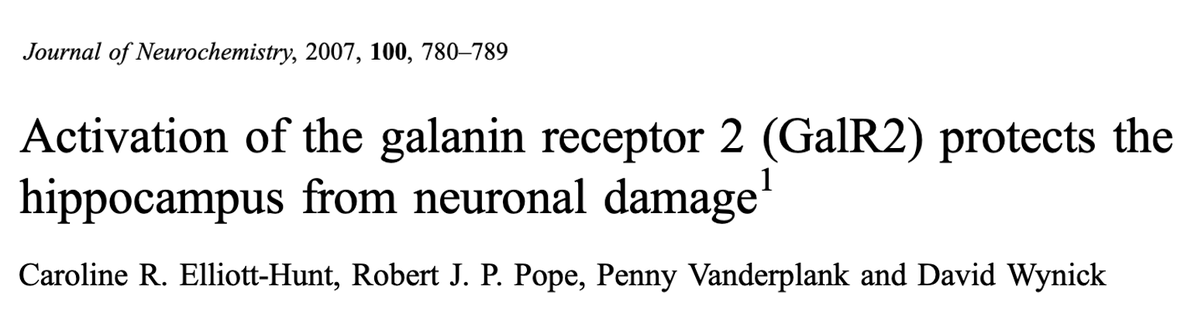
Later in the 2000s, a more complete picture of galanin signaling emerged. New studies showed that galanin surprisingly protected neuronal health in various contexts, suggesting that neurons in AD patients overexpressed galanin to ‘protect’ the neurons from neurotoxic factors http
37.6K views · 194 likes · 1 reposts · 1 replies Open on X →
The first small molecule inhibitors of galanin with potential to pass the blood-brain barrier appeared in the early 2000s. A few high-throughput screens were carried out for GalR1 (galanin receptor 1) antagonism by big pharma companies Schering-Plough (now part of Merck) and J&J,
40.7K views · 203 likes · 1 reposts · 1 replies Open on X →
These observations led scientists in the 90s to hypothesize that a drug that blocked the action of galanin in the brain could increase ACh levels and improve memory, similar to how acetylcholinesterase inhibitors like the AD drug donepezil work. An initial cohort of peptide http
44.8K views · 216 likes · 3 reposts · 1 replies Open on X →
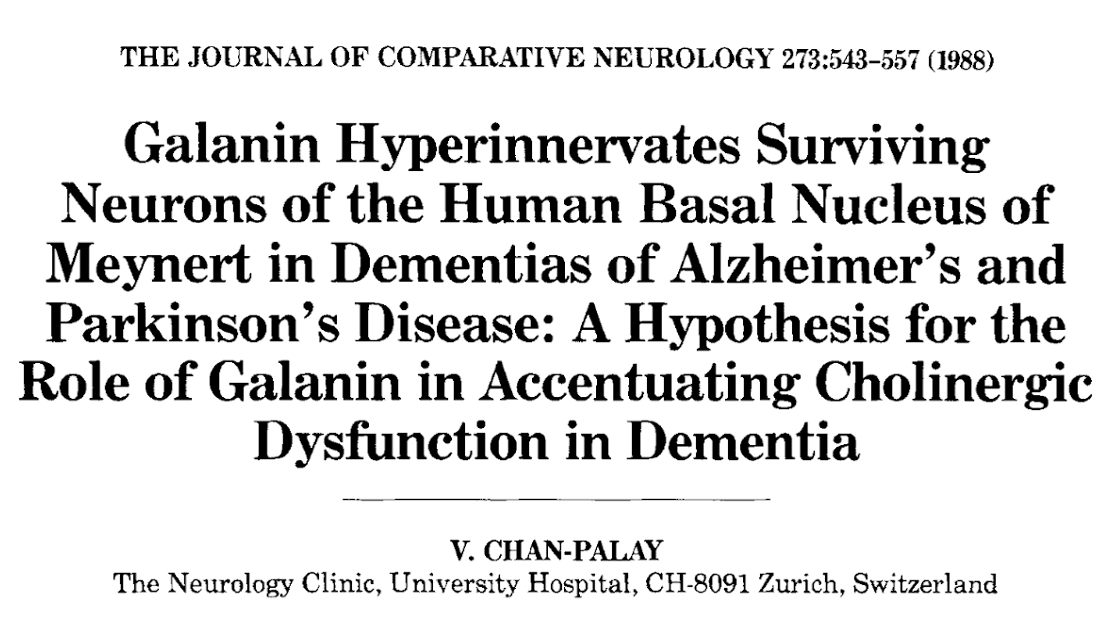
In the 1980s, abnormal galanin signaling was tied to Alzheimer’s through several clinical and scientific observations: (1) brains from deceased AD patients contained many more galanin-producing neurons than normal, concentrated in the basal forebrain - a key memory region in the
49.4K views · 255 likes · 4 reposts · 3 replies Open on X →
What’s GalR1, and what does it have to do with AD? GalR1 is one of three receptors for a molecule called “galanin,” which acts as a signaling molecule in mammalian brains. Galanin isn’t nearly as well-characterized as other neurotransmitters like dopamine or serotonin, yet it’s
55K views · 296 likes · 5 reposts · 1 replies Open on X →
PAC-832 is currently undergoing IND-enabling studies and will be the first galanin-targeting drug in 15 years (and first selective GalR1-targeting drug ever) to enter clinical trials. Read more about this drug here: https://t.co/IRjGZRcVBq (5/16) 56.4K views · 413 likes · 7 reposts · 4 replies Open on X →
PAC-832 also has excellent manufacturability and chemical properties (stability, solubility, etc.), low toxicity, and great pharmacokinetics, including being readily absorbed through the stomach and passing the blood-brain barrier - all less appreciated, but no less critical http
61.3K views · 404 likes · 1 reposts · 3 replies Open on X →
When administered to mice, PAC-832 significantly improves their memory across multiple different memory tests. (3/16) https://t.co/C29SgU9rGS
1:00
66.3K views · 567 likes · 8 reposts · 6 replies Open on X →
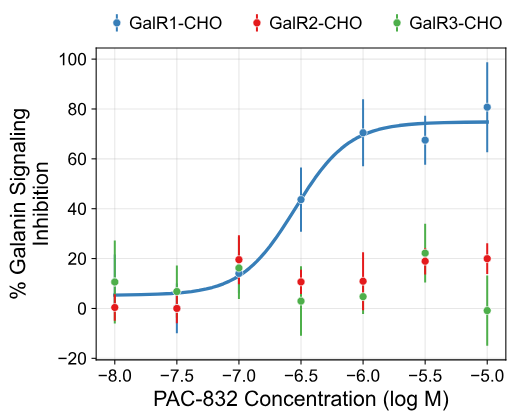
PAC-832 is the first drug of its kind. It works by selectively blocking a receptor in the brain called “galanin receptor 1,” or GalR1. The drug has sub-micromolar potency for GalR1 and >30x selectivity over GalR2/3. (2/16) https://t.co/qg9PCB4dc9
80.8K views · 549 likes · 9 reposts · 9 replies Open on X →
This vial contains a new drug called PAC-832, which I recently invented to treat Alzheimer’s disease. It is the world’s first selective GalR1 antagonist. I designed and synthesized PAC-832 in a chemistry lab I built in my garage. (1/16) https://t.co/J72K43yvlX
1.8M views · 9.6K likes · 711 reposts · 354 replies Open on X →

На фоне аккаунтов своего размера

26 постов за последние 90 дней рядом с диапазоном 10K–100K подписчиков. показывается широко, но откликается мало кто.

Медианные просмотры58 850этот аккаунт1 059медиана для 10K–100K
Охват, %357.04%этот аккаунт3.82%медиана для 10K–100K
Вовлечённость, %0.54%этот аккаунт1.69%медиана для 10K–100K
ПоказательЭтот аккаунтМедиана для 10K–100KОтношение
Медианные просмотры на пост58 8501 05955.6×
Охват (просмотры ÷ подписчики)3.6× audience3.82%93.5×
Вовлечённость0.54%1.69%0.32×

Другие в этом диапазоне →   Сравнить с другим аккаунтом →   Как считаются эти ориентиры →

Growth & engagement

How the posts we collected actually performed: views and reaction rate post by post, what the audience did with them, and where the follower count goes.

Views per post

31K27 Jun
31.1K
38.2K
54.7K
13.9K
6.1M8 Sep
265.1K
406.7K
232.7K
170.9K
280.9K
258K
71.5K
76.1K

Last 14 collected posts, oldest on the left. The scale is logarithmic: one post can outrun the rest a hundred times over.

Engagement rate per post

0.55%27 Jun
0.51%
0.84%
1.87%
2.79%
0.30%8 Sep
0.22%
0.24%
0.25%
0.29%
0.25%
0.51%
5.30%
9.16%

Reactions — likes, reposts, replies and quotes — divided by views. Median for 10K–100K accounts is 1.69%.

What the audience does

Likes72.1%45 366 in total
Reposts3.5%2 230 in total
Replies2.4%1 502 in total
Quotes1.7%1 092 in total
Bookmarks20.2%12 735 in total

Share of every reaction we collected for this account. Replies mean argument, reposts mean endorsement, bookmarks mean the post was worth keeping.

Followers by day

9 Sep

Daily snapshots since 09 Sep 2026; the dashed line is the starting count.

Похожие аккаунты