tweetindex
RU

NASA Universe ✓

@NASAUniverse · Greenbelt, MD · joined 26 Mar 2009

Your backstage pass to the universe and how NASA studies it. Exoplanets, black holes, dark energy, and more!

1 120 159Followers
80Following
12 554Posts total
5.4MViews on collected posts

Последние посты

If this “.” were a black hole, it would have about the mass of Jupiter’s moon Ganymede crammed into it! To become a black hole, it’s not about how much stuff an object has, but how much it’s been smooshed. That's a lot of gravity, period. https://t.co/mW2yFwmOsl https://t.co/69hd
GIF
2.9K views · 52 likes · 10 reposts · 4 replies Open on X →
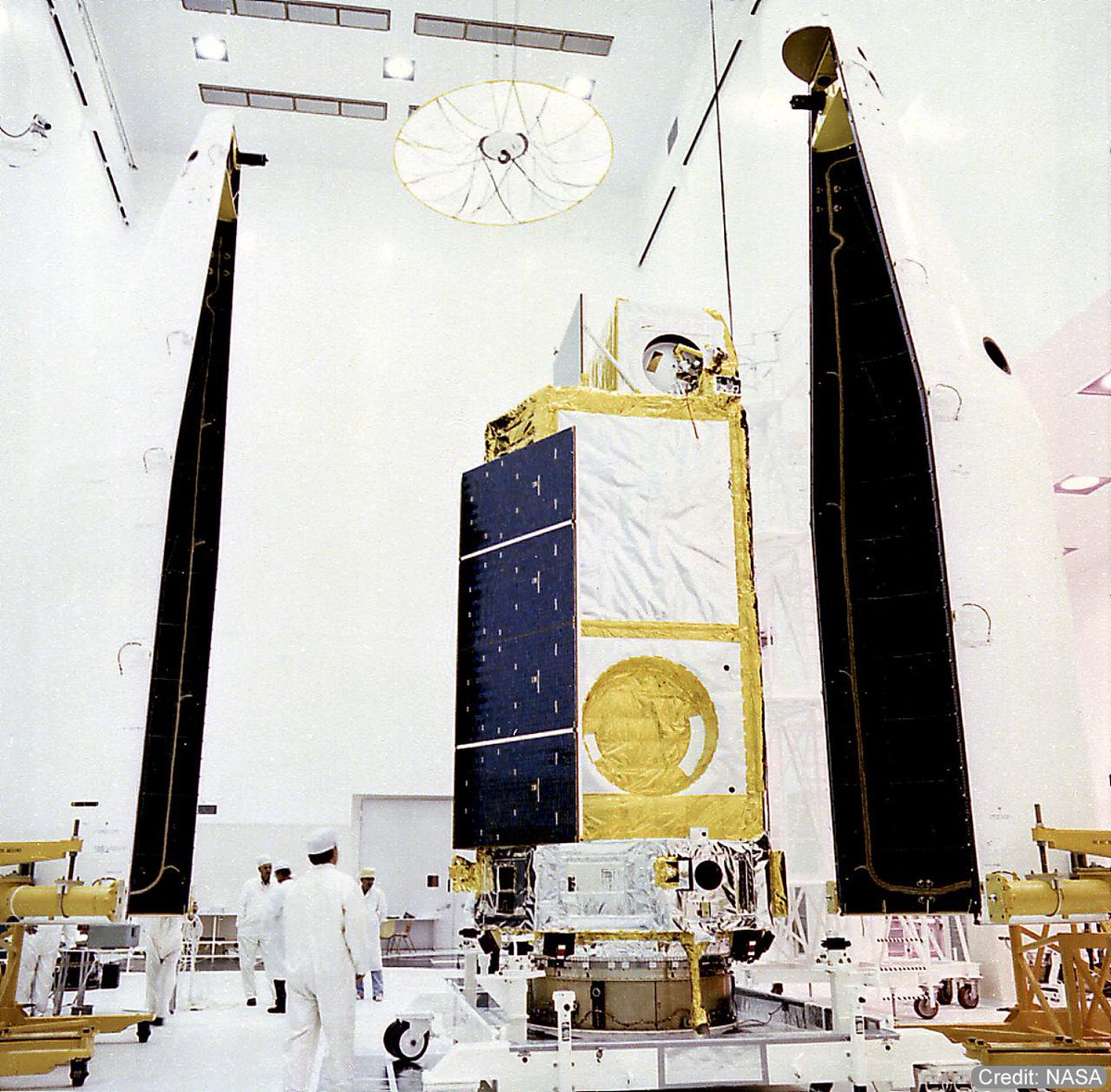
#TBT to Sept. 20, 1979, when NASA’s final High Energy Astronomy Observatory, HEAO 3, launched into space. It mapped the sky in gamma-ray light and made detailed measurements of cosmic ray particles, helping us learn about supernova remnants, distant galaxies, and more. https://t.
This photograph was taken during encapsulation of HEAO 3 into the payload faring that would sit atop its rocket. The spacecraft, near the center of the image, is a tall, boxy structure mostly wrapped in white and shiny gold coverings. The module at its base is covered in shiny silver. Blue, segmented solar panels cover the left side of the spacecraft. On either side of HEAO 3 are the halves of a large white protective shroud that is cylindrical with a cone-shaped tip. Its interior is black. The clean room is stark white and brightly lit, filled with various equipment and structures. Several people stand near the base of the spacecraft, wearing protective white garments and hair coverings. The photo is watermarked “Credit: NASA.”
5.9K views · 86 likes · 12 reposts · 6 replies Open on X →
How does the universe work? Our @NASARoman is poised to help us answer this question by shedding light on dark matter, the invisible glue that holds the universe together. Dark matter makes up about 27% of the universe, but we still don’t know what it is. ⬇️ https://t.co/5raQJKK5
This image, titled “NASA’s James Webb Space Telescope; Deep Field SMACS 0723,” shows Webb’s mid-infrared view of the galaxy cluster on the left and near-infrared view on the right. The background of space is black in both. The mid-infrared image shows fewer sources. Galaxies and stars appear in blue, green, yellow, and red. The stars have short spikes created by the telescope’s optics. The near-infrared image looks sharper than the mid-infrared one and shows thousands of white and orange galaxies and bluish, spiky stars. Many long orange arcs curve around the image center. Some objects appear in both images. At bottom left are arrows indicating the image’s orientation in the sky. Below the image is a color key showing which MIRI and NIRCam filters were used and which visible-light color is assigned to each filter. The image is watermarked “Credit: NASA, ESA, CSA, STScI.”
27.6K views · 705 likes · 101 reposts · 16 replies Open on X →
Zippy particles called cosmic rays travel at nearly light speed across the cosmos, and astronomers have been searching for sites where these particles get their energy. Thanks to our NuSTAR telescope, we’ve found another candidate: pulsar wind nebulae. https://t.co/EIM8OJp71U htt
This composite image shows a supernova remnant with a pulsar wind nebula in the center in X-ray and radio light. A large, deep purple bubble fills the image, extending outside the top and bottom edges. At the center of the bubble is a bright white dot, marking the location of the crushed stellar core. Offset from the center is a hazy red region, which is a pulsar wind nebula. Another aqua blob in the lower right of the supernova remnant is an unrelated X-ray source. The image is watermarked “Credit: Brunelli et al. (2026)/MeerKAT (Heywood et al. 2022)/H. Earnshaw.”
20.8K views · 358 likes · 41 reposts · 6 replies Open on X →
The Perseus galaxy cluster makes us want to cozy up with a seasonal beverage. Captured by @ChandraXray, the enormous waves of gas making this cosmic latte art likely formed billions of years ago due to the flyby of a smaller galaxy cluster. More: https://t.co/bGGAFcjhTU https://t
GIF
32.7K views · 715 likes · 87 reposts · 23 replies Open on X →
It’s okay to be different! Omega Centauri is the largest, brightest, and most massive globular cluster in the Milky Way. But it might not even be a globular cluster. It may be the core of a dwarf galaxy captured by the Milky Way and stripped of its outer stars. #MondayMotivation
This ultraviolet image of Omega Centauri is a composite of three images with colors selected to emphasize different UV wavelengths. It was captured by NASA’s Neil Gehrels Swift Observatory and features thousands and thousands of tiny colorful dots that are clumped together on the black background of space. The majority of the dots, which represent stars at varying stages of their lives, are clustered slightly below the center of the image in a bright region. The density of the stars decreases toward the edges of the image, with just a few dozen stars scattered around the edges of the cluster. The image is watermarked “Credit: NASA/Swift/S. Holland (GSFC), M. Siegel and E. Fonseca (PSU).”
25.9K views · 800 likes · 117 reposts · 19 replies Open on X →
For the first time, astronomers directly observed stellar wind flowing from a giant star onto its companion, causing powerful X-ray flares. Data from the XRISM telescope, which is led by @JAXA_en in partnership with @NASA and with contributions from @ESA, revealed the cause. 🧵 ht
1:02
49.4K views · 1.7K likes · 317 reposts · 43 replies Open on X →
For as long as we’ve been looking to the sky, humans have been drawn to the Moon. By studying the Moon in many different forms of light we learn about its composition, surface conditions, and much more. Observe the Moon with us this weekend: https://t.co/nrybbPGcYn https://t.co
0:29
28.7K views · 335 likes · 64 reposts · 9 replies Open on X →
While our Swift satellite was designed to study faraway cosmic explosions, it has also observes nearby icy comets! These rocky snowballs are leftover from the solar system’s formation, and Swift watched one’s spin slow down: https://t.co/XyIy1BCV2z #CollectRocksDay https://t.co/h
GIF
34.9K views · 442 likes · 59 reposts · 11 replies Open on X →
@NASAUniverse this is so pretty 67 views · 1 likes · 0 reposts · 0 replies Open on X →
#OTD in 2015, @LIGO detected wiggles in space-time from a pair of merging black holes. This event, called GW150914, created a new black hole and ushered in the first direct detection of gravitational waves, a new type of signal astronomers can study. https://t.co/zoilY0wrcH https
GIF
44.5K views · 936 likes · 137 reposts · 29 replies Open on X →
@NASAUniverse Nearly a millennium later, the explosion is still unfolding before us. Watching the Crab Nebula change turns a historical event into something we can observe in real time. 373 views · 2 likes · 0 reposts · 0 replies Open on X →
@NASAUniverse bruh i will get you there. don’t worry. 😉 148 views · 1 likes · 0 reposts · 0 replies Open on X →
The supernova responsible for the Crab Nebula was observed in 1054 and cataloged as a “guest star” by Chinese astronomers. Over the past two decades, we’ve been able to map the changes in the cloud of debris left behind by this explosion. #MondayMotivation https://t.co/GNadR8QGll
This composite image of the Crab Nebula combines X-ray and infrared light from NASA’s Chandra and Webb telescopes. The nebula is an oval with a complex interior structure against a black background. On its exterior are curtains of glowing red and orange fluffy material. Its interior shell has large-scale loops of mottled filaments of yellow-white and green, studded with clumps and knots. Nestled within is a blue and purple shape resembling a spinning toy top made of white wispy clouds, resting on its side. In the center is a ball of brilliant white light, which is the neutron star. It is the remnant of the star that exploded to create this nebula. From the bottom of the neutron star, a jet of matter is rushing downward, like scalding hot steam being released from a valve. The image is watermarked “Credit: X-ray: NASA/CXC/SAO; Infrared: NASA/STScI; Image Processing: NASA/CXC/SAO/J. Major.”
35.6K views · 1.5K likes · 222 reposts · 19 replies Open on X →
#TBT to Sept. 6, 2023, when the XRISM telescope launched from Japan! Led by @JAXA_en in partnership with @NASA and with contributions from @ESA, XRISM helps us study some of the hottest spots and most energetic events in the cosmos. Catch up with XRISM: https://t.co/dA6J2GeW27 h
This illustration depicts JAXA’s XRISM spacecraft in orbit in star-filled space above Earth along with a variety of cosmic objects the telescope will observe. The satellite is roughly cylindrical and wrapped in crinkled gold material. One end of XRISM features several small circular openings. Shiny, black solar panels extend horizontally from the top of the spacecraft with three segments on each side. Above XRISM, from left to right, are dozens of small galaxies surrounded by swirls of pink and purple gas, light warped into a circular shape with a flat disc by the extreme gravity of a black hole, a wispy, butterfly-shaped nebula, and over a dozen larger galaxies in a variety of shapes, including glowing elliptical galaxies and majestic multiarmed spirals. The image is watermarked with “Artist’s concept” and “Credit: JAXA.”
14.8K views · 229 likes · 35 reposts · 9 replies Open on X →
This week, Katalyst Space continued to demonstrate capabilities of its LINK robotic servicing satellite, adjusting its orbit to come within about 7.5-9 miles (12-15 kilometers) of our Swift observatory. LINK will not make any closer approach to Swift during its remaining https://
LINK fires all three of its xenon-fueled thrusters simultaneously in this image captured by the spacecraft August 30, 2026. Three blue flames emit from three thrusters at the rear of a spacecraft, as seen from a side profile looking out toward space. There is a metallic ring encapsulating the back of the satellite. The image is watermarked “Credit: Katalyst Space.”
A solar panel on Katalyst Space’s LINK robotic servicing spacecraft is seen in orbit, in this image captured by one of LINK’s cameras August 24, 2026. A large black and gold solar panel extends from the side of a spacecraft in orbit. Earth takes up most of the background, and the satellite is a reflective silver line on the left side of the image. The image is watermarked “Credit: Katalyst Space.”
33.5K views · 580 likes · 95 reposts · 6 replies Open on X →
The stellar remnant known as pulsar J0002 is hurtling through space at nearly 2.5 million miles per hour away from the expanding debris of the supernova that created it. It's traveling so fast that it will eventually leave our galaxy. #MondayMotivation https://t.co/sBFwJHvx1b
The ghostly bubble of supernova remnant CTB 1 is captured in observations from the VLA (Very Large Array) and the Dominion Radio Astrophysical Observatory’s Canadian Galactic Plane Survey. The golden curved rim of the remnant’s shell is near the center of the image, with the straight, glowing trail from pulsar J0002+6216 pointing toward the lower left. The image is filled with hazy blue clouds and dotted with off-white orbs of varying sizes and brightness. This image is watermarked with “Credit: Composite by Jayanne English, University of Manitoba, using data from NRAO/F. Schinzel et al., DRAO/Canadian Galactic Plane Survey and NASA/IRAS.”
30.5K views · 889 likes · 135 reposts · 25 replies Open on X →
Congrats, @NASARoman team — what an amazing launch! We are excited to follow the telescope’s journey to L2 and can’t wait to see what it reveals about the universe. 33.8K views · 616 likes · 105 reposts · 12 replies Open on X →
Ad astra ⭐ At 7:26am ET (1126 UTC) on Aug. 30, @NASARoman took to the skies en route to its new home 1 million miles away from Earth. It should reach its final destination in one month: https://t.co/GD5THXPBLn https://t.co/99GE5f6U90
A SpaceX Falcon Heavy rocket carrying NASA’s Nancy Grace Roman Telescope transiting the Sun as it lifts off to space. The rocket's trail creates a fluffy plume that extends below the Sun. The background sky is a golden haze. Credit: NASA/John Kraus
1M views · 5.9K likes · 959 reposts · 154 replies Open on X →
LIVE NOW! Tune in with us to watch our newest space telescope @NASARoman start its million-mile journey to help us investigate the mysteries of the universe: https://t.co/NXHikEO4UO 18.9K views · 153 likes · 32 reposts · 5 replies Open on X →
LIVE: Today’s the day! @NASARoman is getting ready to head to its new home 1 million miles from Earth, where it will change how we view the universe. Liftoff is currently scheduled for 7:26am ET (1126 UTC). https://t.co/fJi2wd5ztm 1.9M views · 4.1K likes · 957 reposts · 208 replies Open on X →
Set your alarms … tomorrow is launch day for @NASARoman, our newest space telescope! Learn about Roman, and join us for launch on Aug. 30 at 7:26 a.m. EDT (but we’ll be up a little earlier for the livestream): https://t.co/1hz6PH4FLZ 31.6K views · 439 likes · 76 reposts · 7 replies Open on X →
Time to explore the cosmos! 🔭 @NASARoman is ready to lift off from @NASAKennedy at 7:26am ET (1126 UTC) on Aug. 30. Join us here for our live coverage beginning at 6:20am ET (1020 UTC). https://t.co/H22b3CCQKR
NASA’s Nancy Grace Roman Space Telescope, encapsulated in a protective payload fairing atop a SpaceX Falcon Heavy rocket, is seen at sunrise at Launch Complex 39A at NASA’s Kennedy Space Center in Florida. Photo Credit (NASA/Joel Kowsky)
1.2M views · 8.3K likes · 1.2K reposts · 226 replies Open on X →
Our Swift observatory is back in its science era. Two of its telescopes resumed operation this week, and the team hopes to have the third science instrument back online soon. After the scaling back of a commercial mission that would have boosted the sinking spacecraft’s altitude, 37K views · 665 likes · 89 reposts · 14 replies Open on X →
@NASAUniverse I remember this :) thanks! 5 views · 0 likes · 0 reposts · 0 replies Open on X →
Last is a galaxy that flares like clockwork! With TESS and Swift, astronomers identified the most predictably and frequently flaring active galaxy yet. ASASSN-14ko, which is 570 million light-years away, brightens every 114 days! https://t.co/ERmzAl3VSx https://t.co/oEkK5NgSap
1:42
11K views · 67 likes · 11 reposts · 1 replies Open on X →
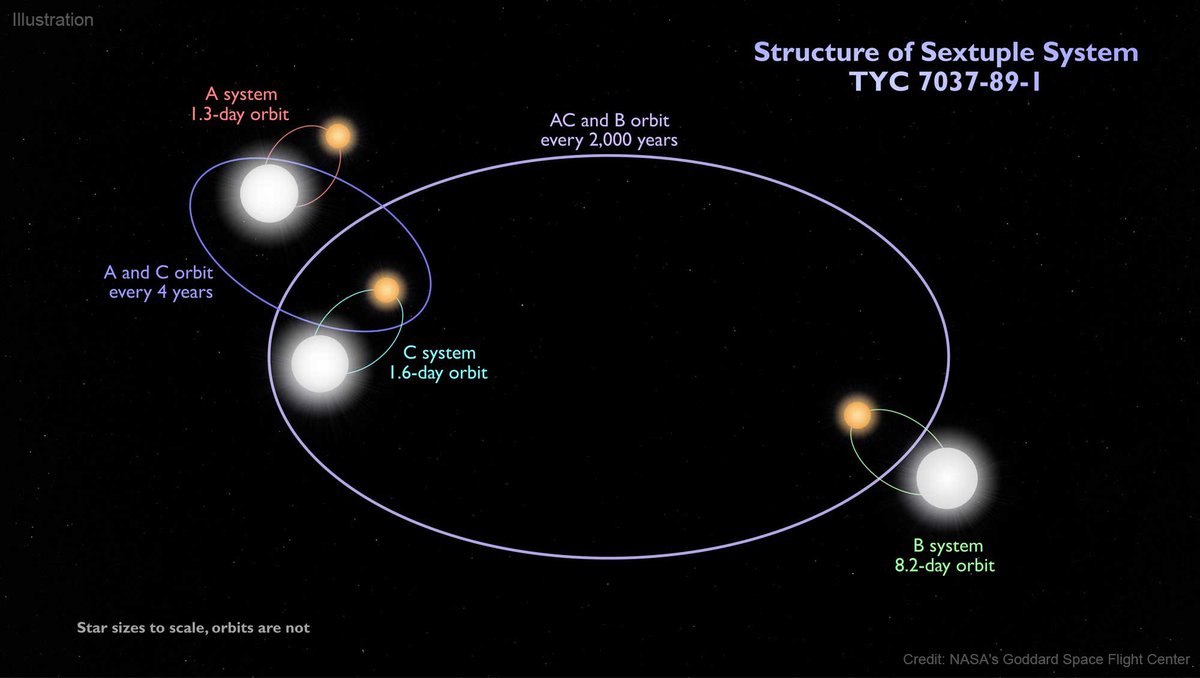
For the first time, astronomers found a six-star system where all stars undergo eclipses. They used data from TESS, a supercomputer, and automated eclipse-identifying software to help make the discovery: https://t.co/TmLzD6gLJS https://t.co/ULHIHqzOgQ
This diagram depicts six stars that interact with each other in complex orbits. The stars are arranged in pairs: Systems A, B, and C, are each shown with one larger white star and one smaller orange star. The two stars of System A, in the upper left, are connected by a red oval and labeled "1.3-day orbit." The two stars of System C, just below System A, are connected by a teal oval and labeled "1.6-day orbit." These two systems orbit each other, shown as a larger blue oval connecting the two and labeled "A and C orbit every 4 years." In the bottom right of the image, the two stars of System B are connected by a green oval and labeled "8.2-day orbit." System B orbits the combined AC system, shown as a very large lilac oval labeled "AC and B orbit every 2,000 years." A caption at the bottom of the image notes, "Star sizes are to scale, orbits are not." The image is watermarked with “Illustration” and “Credit: NASA's Goddard Space Flight Center.”
28K views · 152 likes · 29 reposts · 4 replies Open on X →
Though TESS may be a planet-hunter, its unwavering month-long stares also help us study black holes! In 2019, TESS saw a black hole tear apart a star in a tidal disruption event. Learn more about this rare, star-destroying event: https://t.co/QqQBQqdkpP https://t.co/SNCMfLMHWi
GIF
5.9K views · 38 likes · 4 reposts · 1 replies Open on X →
Studying planets often helps us learn about stars too! Data from TESS & Spitzer helped scientists detect a planet around young, flaring star AU Mic, providing a unique way to study how planets form, evolve, and interact with stars. https://t.co/qzzjecMJKo https://t.co/qNO1KU2Mqk
1:40
5.3K views · 31 likes · 3 reposts · 1 replies Open on X →
Happy 5th launch anniversary, TESS! Check out this thread to see five of our favorite TESS discoveries so far! 🧵 112.6K views · 329 likes · 48 reposts · 4 replies Open on X →

На фоне аккаунтов своего размера

24 постов за последние 90 дней рядом с диапазоном 1M–10M подписчиков. показывается далеко за пределами своей аудитории, и она отвечает.

Медианные просмотры31 061этот аккаунт14 648медиана для 1M–10M
Охват, %2.77%этот аккаунт0.74%медиана для 1M–10M
Вовлечённость, %1.91%этот аккаунт0.70%медиана для 1M–10M
ПоказательЭтот аккаунтМедиана для 1M–10MОтношение
Медианные просмотры на пост31 06114 6482.12×
Охват (просмотры ÷ подписчики)2.77%0.74%3.75×
Вовлечённость1.91%0.70%2.73×

Другие в этом диапазоне →   Сравнить с другим аккаунтом →   Как считаются эти ориентиры →

Growth & engagement

How the posts we collected actually performed: views and reaction rate post by post, what the audience did with them, and where the follower count goes.

Views per post

35.6K14 Sep
148
373
44.5K
67
34.9K16 Sep
28.7K18 Sep
49.4K
25.9K21 Sep
32.7K22 Sep
20.8K
27.6K23 Sep
5.9K24 Sep
2.9K

Last 14 collected posts, oldest on the left. The scale is logarithmic: one post can outrun the rest a hundred times over.

Engagement rate per post

4.84%14 Sep
0.68%
0.54%
2.50%
1.49%
1.47%16 Sep
1.43%18 Sep
4.28%
3.63%21 Sep
2.53%22 Sep
1.95%
2.99%23 Sep
1.75%24 Sep
2.25%

Reactions — likes, reposts, replies and quotes — divided by views. Median for 1M–10M accounts is 0.70%.

What the audience does

Likes79.2%30 131 in total
Reposts13.0%4 958 in total
Replies2.3%862 in total
Quotes1.2%453 in total
Bookmarks4.3%1 647 in total

Share of every reaction we collected for this account. Replies mean argument, reposts mean endorsement, bookmarks mean the post was worth keeping.

The follower curve appears once this account has two daily snapshots — we take one a day, and this one is on its first.

Похожие аккаунты