tweetindex
RU

NASA Webb Telescope ✓

@NASAWebb · Lagrange Point 2 · joined 07 Apr 2009

The Official *NASA* Webb X account. The world's most powerful space telescope. Launched: Dec. 25, 2021. First images revealed: July 12, 2022.

3 517 677Followers
63Following
11 568Posts total
2.6MViews on collected posts

Последние посты

Within this star-forming nebula (captured by Webb) are the smallest brown dwarfs ever detected. Neither planet nor star, these objects are formed like stars, raising questions about the star formation process. https://t.co/s58sxdx1dl https://t.co/9FV6L3J6Ia
A star-forming region. The left two thirds of the image is blanketed in thick clouds of green and yellow gas and dust that form swirling patterns. Some of the gas is spread into thin, thready wisps. The right third of the image is the black background speckled with stars and multi-colored dots that represent distant galaxies. Bright stars are scattered throughout the clouds, with the densest cluster situated in the center of the scene. Each is crowned with six long spikes and two shorter spikes created by the optics of the telescope’s mirrors.
131.8K views · 2.7K likes · 492 reposts · 54 replies Open on X →
Scientists used Webb and @NASAHubble to study some of the most far-flung bodies in our solar system, Trans-Neptunian Objects, unexpectedly finding that the number and colors followed the same relationships as their larger family members. More: https://t.co/Z1GtQHZ2SP https://t.
2:38
156.3K views · 1.1K likes · 198 reposts · 34 replies Open on X →
“Being a star just means that you just find your own special place and that you shine where you are.” - Dolly Parton ✨ An irregular galaxy might seem like an odd place for so many new stars to shine, yet multitudes are forming within the gas that crowds Arp 263. https://t.co/DuT
An irregular galaxy, appearing like a broad band of tiny stars. It is denser on one side, with a faint cloud of gas among the stars. Clumps of brighter points are newly formed stars, with the largest lights being star clusters, and with many surrounded in glowing blue gas clouds. Plumes of red dust surround the galaxy. A foreground star appears
125.8K views · 2K likes · 292 reposts · 43 replies Open on X →
How close is too close to a black hole? Asking for a friend. 😬 Webb just revealed dust and water surviving in the extreme environment of a star located near our Milky Way's supermassive black hole, Sagittarius A*! https://t.co/GVqMLs39gn https://t.co/DwOBwJIOky
A bright, densely populated star cluster lies near the centre of the image. One yellow star is labeled IRS 3. A spot in the middle is labeled Sgr A*.
126.6K views · 1.3K likes · 197 reposts · 28 replies Open on X →
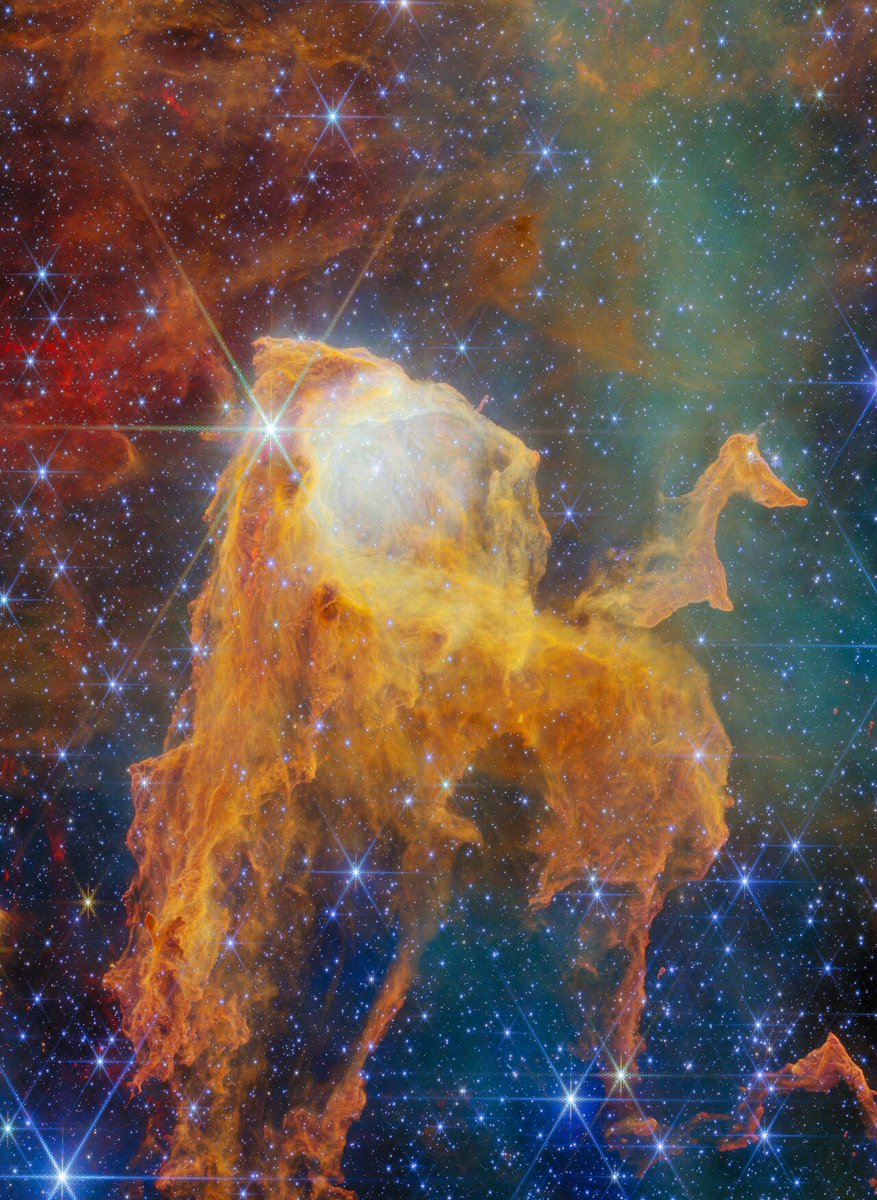
What animal do you see in this Webb image?! A bird? An elephant? A giraffe? Let your imagination run wild! This is Webb’s infrared view of part of the Carina Nebula, a star-forming region also home to the Cosmic Cliffs, which was one of the first images released by Webb. http
 A region of space filled with bright stars and clouds of gas. In the center, the densest clouds form the shape of a chest with its lid open. The chest appears to glow from within. At its base it breaks apart into long pillars of thick gas. Many of the gas clouds in the background are dark orange globules, while others form large, pale hazes. A few brightly shining stars lie in the foreground, the biggest and brightest in front of the chest’s lid.
128.9K views · 1.7K likes · 270 reposts · 116 replies Open on X →
@NASAWebb Reminds me of the early stages of cellular life… a Zygote https://t.co/L4cZZVRCwn 522 views · 10 likes · 0 reposts · 0 replies Open on X →
Understanding why the swept-up gas has a complex structure of rings and shells, a common feature in nebula of this kind, is an ongoing endeavor. https://t.co/NLuNLoVZAk (This view is Webb's Lion Nebula in mid-infrared light alone.) https://t.co/83kZFYp4lZ 32K views · 283 likes · 28 reposts · 3 replies Open on X →
In the Lion Nebula’s case, its white dwarf is “cooking” everything from the inside and producing a bubble of ionized gas as it does. The gas bubble, which forms the lion’s face, is expanding over time and destroying dust that is in its path. 34.8K views · 211 likes · 12 reposts · 2 replies Open on X →
It's the circle of life… Webb's look at the Lion Nebula, the remains of a dying lower-mass star, is in both the mid and near-infrared. Though massive stars undergo supernova explosions at the end of their lives, lower-mass stars shed their outer layers. https://t.co/9dmHxUlHio
Webb’s near and mid infrared combined image of planetary nebula NGC 2392, the Lion Nebula, against the black background of space. The nebula is at center, circular in shape, and looks like a male lion’s head. In the center is a small, pinkish-white circle with eight-point diffraction spikes, a white dwarf star. Surrounding the star are purple-pink cavernous bubbles and shell-like rings. The bubbles and shells collectively form an oval with two small, wide arcs near the top, reminiscent of a lion’s face and its ears. What appears to be extended outward from the lion’s face is a thick ring of purple-blue material. The width of the ring is consistent throughout and resembles a mane. The area closest to the lion’s face looks cloudy, while the edges of the mane look like there are clumps of dust with comet-like tails. In the background are distant galaxies and stars. Some galaxies are yellow and orange points of light and others have spiral structures. Some stars have diffraction spikes.
133.8K views · 3.5K likes · 631 reposts · 68 replies Open on X →
@NASAWebb To God be the glory for all things He has created in the Universe and in us. 209 views · 3 likes · 0 reposts · 0 replies Open on X →
@NASAWebb I saw a news report this week about a 'new Hubble' called Roman. Is there going to be an X account we can follow for the new 'scope? 249 views · 2 likes · 0 reposts · 1 replies Open on X →
@NASAWebb Great time to be alive! Thx y‘all 😎👍🏻 111 views · 1 likes · 0 reposts · 0 replies Open on X →
This July was our 4th science anniversary, and the results have been fascinating! Bringing us previously unseen details from all throughout the universe to right here in our own solar system, Webb has given scientists, and the world, a powerful new set of tools. https://t.co/Ayp7
5:24
145.3K views · 1.1K likes · 269 reposts · 44 replies Open on X →
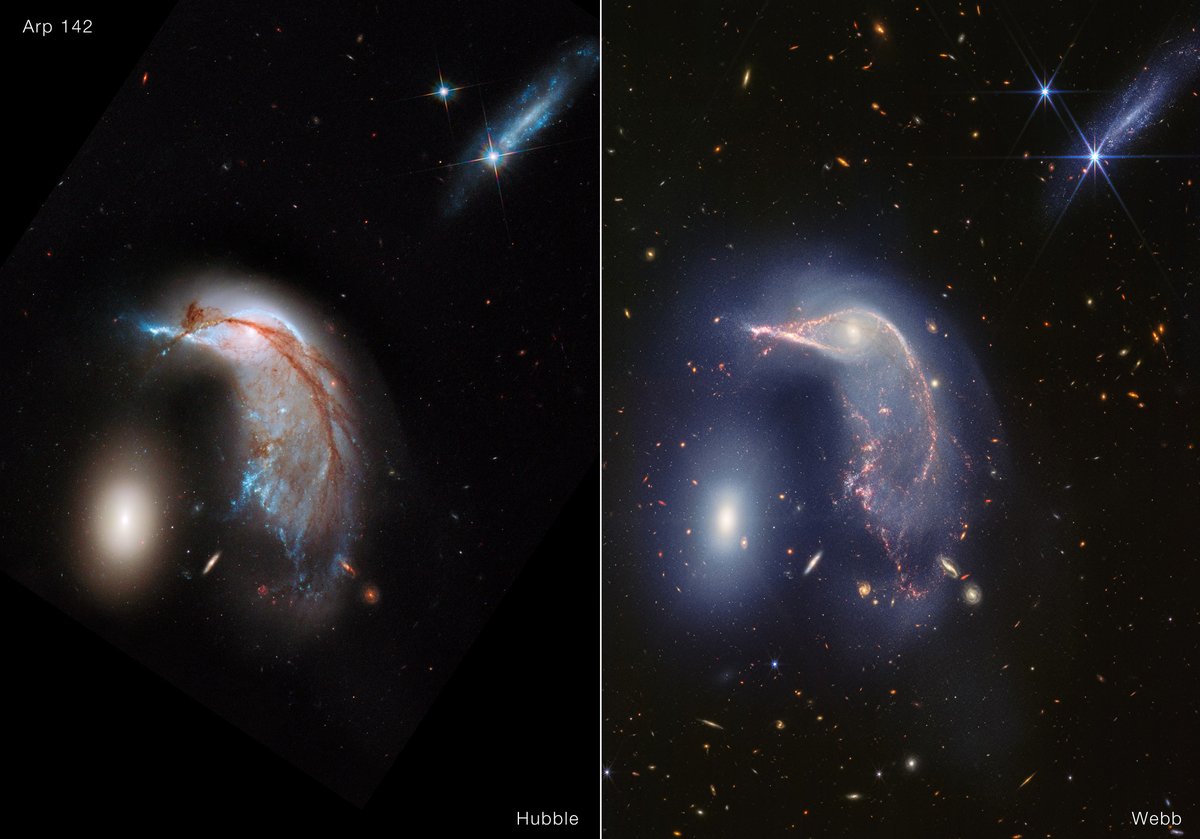
@NASAWebb This aligned 2-frame GIF shows what Arp 142 (NGC 2936 "penguin" and 2937 "egg") look like in optical light to Hubble and infrared wavelengths to JWST. Bands of dust in 2936 become nearly transparent in infrared. https://t.co/QTAJP8n5G5
GIF
27.3K views · 150 likes · 32 reposts · 6 replies Open on X →
@NASAHubble Since Webb started science, it has discovered the most distant known galaxy, opened a new window into the atmospheres of other worlds, and provided unparalleled insight into the birth of stars and planets. We can’t wait to see how Webb will guide the next generation o 66.5K views · 355 likes · 33 reposts · 2 replies Open on X →
Which came first for this Penguin and its Egg? @NASAHubble took the visible-light view on the left in 2013. On the right side is Webb's near-infrared image. With its sensitive vision, Webb peers through dust, intensifies bright objects, and highlights unseen stars and galaxies.
Frame is split down the middle: Hubble’s visible light image at left, and Webb’s near-infrared image at right. Both show the Egg at left and the Penguin at right. In Hubble’s view, the Penguin is highly detailed, with a bright blue beak, body, and tail that is covered in an arc of bright brown dust. The Egg, to its left, appears bright, gleaming yellowish white. At top right is another galaxy seen from the side, about as long as the Egg’s height. Dozens of galaxies and stars appear in the background. Webb’s near-infrared image shows the Penguin’s beak, head, and back in shades of pink. It’s tail-like region is more diffuse, and a mix of lighter pinks and blues. The Egg appears slightly larger in blue layers. A semi-transparent blue forms an upside down U over top of both galaxies. At top right, an edge-on galaxy has many more pinpricks of light, which are stars. Thousands of galaxies and stars appear in the background. Some galaxies are shades of orange, while others are white.
74K views · 691 likes · 112 reposts · 10 replies Open on X →
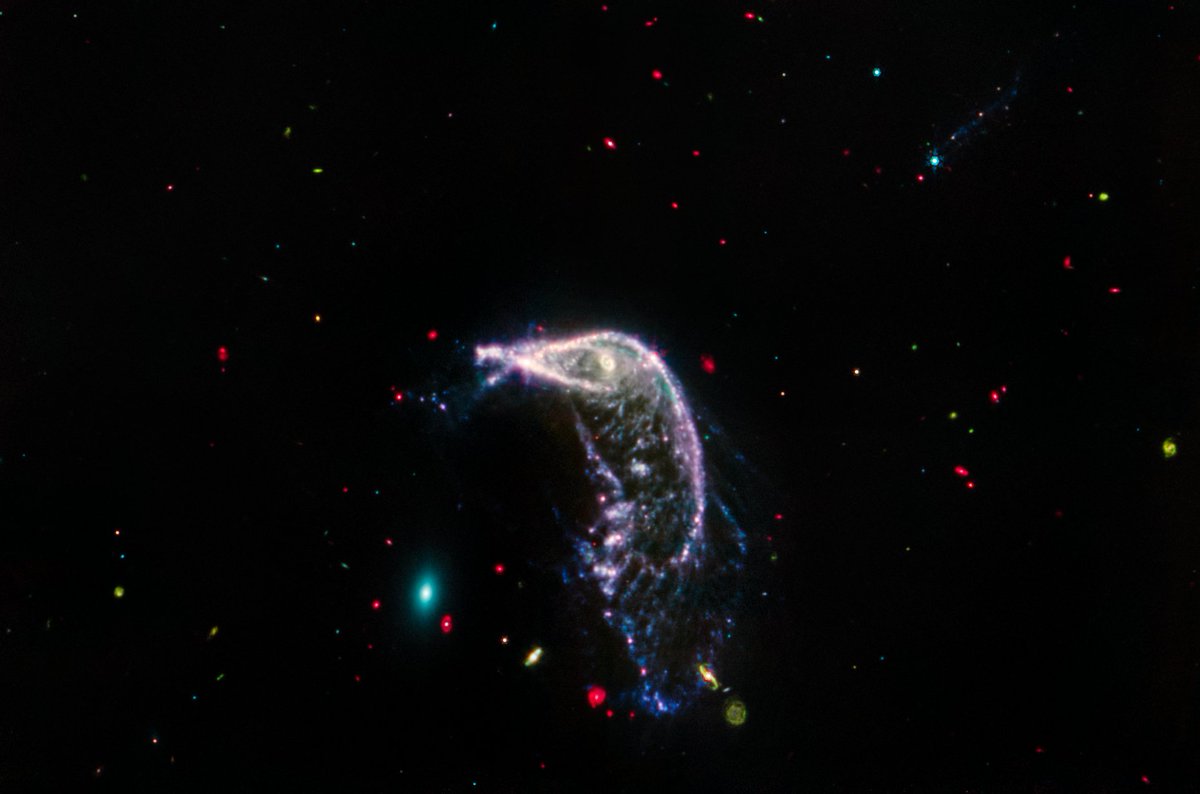
The image above combines near-infrared and mid-infrared data from Webb. Seen in only mid-infrared light (below), the Egg appears as a much smaller teal oval. These wavelengths predominantly show the oldest stars in the galaxy, which has lost or used up most of its gas and dust. h
Two interacting galaxies known as Arp 142 in a horizontal image taken in mid-infrared light. At left is NGC 2937, an elliptical galaxy that looks like a tiny teal oval and is nicknamed the Egg. At right is NGC 2936, a distorted spiral galaxy nicknamed the Penguin, which is significantly larger. A beak-like region points toward the Egg, but lies far above it. Where the eye would be is an opaque, almost washed-out pink spiral. This galaxy’s distorted pink, purple, and blue arms create the bird’s beak, back, and tail. The tail, which is closer to the Egg, is wide and layered, like a beta fish’s tail. The Penguin and the Egg appear very separate. The galaxy at top right, PGC 1237172, is barely visible. A brighter slightly larger blue foreground star that is overtop this galaxy has tiny diffraction spikes. Throughout the image are tiny galaxies in bright reds, greens, and blues. The background of space is black.
12.3K views · 347 likes · 44 reposts · 3 replies Open on X →
The galaxies have been merging for tens of millions of years, and will eventually become one. In fact, only about 100,000 light-years separate the Penguin and the Egg. To compare, our Milky Way and its neighboring Andromeda galaxy are about 2.5 million light-years apart! 9.9K views · 245 likes · 25 reposts · 3 replies Open on X →
Penguins make excellent parents, even in space. 🐧 Celebrating 2 years of science, this new Webb image shows 2 galaxies: a Penguin (NGC 2936) guarding an Egg (NGC 2937). Webb reveals they are in a cosmic hug, joined together by a blue haze of stars & gas: https://t.co/z85VcgDLOP
Arp 142, two interacting galaxies, observed in near- and mid-infrared light. At left is NGC 2937, nicknamed the Egg. Its center is the brighter and whiter. There are six diffraction spikes atop its gauzy blue layers. At right is NGC 2936, nicknamed the Penguin. Its beak-like region points toward and above the Egg. Where the eye would be is a small, opaque yellow spiral. The Penguin’s distorted arms form the bird’s beak, back, and tail. The tail is wide and layered, like a beta fish’s tail. A semi-transparent blue hue traces the Penguin and extends from the galaxy, creating an upside-down U over top of both galaxies. At top right is another galaxy seen from the side, pointing roughly at a 45-degree angle. It is largely light blue. Its length appears approximately as long as the Egg’s height. One foreground star with large, bright blue diffraction spikes appears over top of the galaxy and another near it. The entire black background is filled with tiny, extremely distant galaxies.
1.4M views · 5.1K likes · 1.1K reposts · 105 replies Open on X →

На фоне аккаунтов своего размера

13 постов за последние 90 дней рядом с диапазоном 1M–10M подписчиков. показывается далеко за пределами своей аудитории, и она отвечает.

Медианные просмотры125 820этот аккаунт14 648медиана для 1M–10M
Охват, %3.58%этот аккаунт0.74%медиана для 1M–10M
Вовлечённость, %1.22%этот аккаунт0.70%медиана для 1M–10M
ПоказательЭтот аккаунтМедиана для 1M–10MОтношение
Медианные просмотры на пост125 82014 6488.59×
Охват (просмотры ÷ подписчики)3.58%0.74%4.83×
Вовлечённость1.22%0.70%1.75×

Другие в этом диапазоне →   Сравнить с другим аккаунтом →   Как считаются эти ориентиры →

Growth & engagement

How the posts we collected actually performed: views and reaction rate post by post, what the audience did with them, and where the follower count goes.

Views per post

27.3K12 Jul
145.3K31 Jul
111
249
209
133.8K10 Aug
34.8K
32K
522
128.9K11 Aug
126.6K12 Aug
125.8K27 Aug
156.3K8 Sep
131.8K15 Sep

Last 14 collected posts, oldest on the left. The scale is logarithmic: one post can outrun the rest a hundred times over.

Engagement rate per post

0.72%12 Jul
0.95%31 Jul
0.90%
1.20%
1.44%
3.14%10 Aug
0.65%
0.98%
1.92%
1.64%11 Aug
1.22%12 Aug
1.84%27 Aug
0.85%8 Sep
2.47%15 Sep

Reactions — likes, reposts, replies and quotes — divided by views. Median for 1M–10M accounts is 0.70%.

What the audience does

Likes77.6%20 636 in total
Reposts14.1%3 755 in total
Replies2.0%522 in total
Quotes1.2%326 in total
Bookmarks5.1%1 366 in total

Share of every reaction we collected for this account. Replies mean argument, reposts mean endorsement, bookmarks mean the post was worth keeping.

Followers by day

19 Sep22 Sep

Daily snapshots since 19 Sep 2026; the dashed line is the starting count.

Похожие аккаунты