tweetindex
TH

Nicholas A. Christakis

@NAChristakis · Vermont, USA · joined 29 Aug 2012

Sterling Professor of Social and Natural Science at Yale. Physician. Author of Apollo's Arrow; Blueprint; and Connected. ::: More active at azure skies.

185 824Followers
750Following
53 694Posts total
59.4KViews on collected posts

โพสต์ล่าสุด

Fine essay via @paulg "How Universities Should Prepare Founders": https://t.co/EMKqB3Nimt Would that universities would listen, as there would be other benefits to pedagogy, too. "The people you need to impress are users, not investors, and the way you impress them is with 6.2K views · 11 likes · 1 reposts · 1 replies Open on X →
@NAChristakis Super cool thread, Dr. Christakis. I was at the ASA conference earlier this month & one of your co-authors presented your joint work on social networks and homophily. So happy to see cognitive social psychology and network science complementing each other. 28 views · 1 likes · 0 reposts · 0 replies Open on X →
Experiments and field trials show how to exploit an understanding of social network structure and function to enhance human welfare. We can use an understanding of social networks, and of social contagion theory, to intervene in human populations, whether online or in person. 20/ 1.5K views · 8 likes · 0 reposts · 1 replies Open on X →
Humans are naturally embedded in complex, face-to-face social networks. These networks obey particular mathematical and social rules, and taking this into account offers profound new opportunities to understand and modify human behavior and collective outcomes , including public
183 views · 4 likes · 0 reposts · 1 replies Open on X →
Social contagion is relevant to phenomena as diverse as public goods production, inequality, technology adoption, economic productivity, political mobilization, misinformation, violence, emotional experience, health behavior, and epidemic disease. 19/ 1.5K views · 6 likes · 0 reposts · 1 replies Open on X →
“Bringing Leaders of Network Subgroups Closer Together Does Not Facilitate Consensus,” Scientific Reports2024;14:30183. We find no evidence that the geodesic distance between leaders of two groups is a significant factor in the probability of reaching consensus. 182 views · 4 likes · 1 reposts · 1 replies Open on X →
“Simple Autonomous Agents Can Enhance Creative Semantic Discovery in Human Groups,” Nature Communications2024;14:5212. Groups are better able to identify and preserve innovations than individuals. We show that bots can enhance the creativity of human groups. 181 views · 5 likes · 1 reposts · 1 replies Open on X →
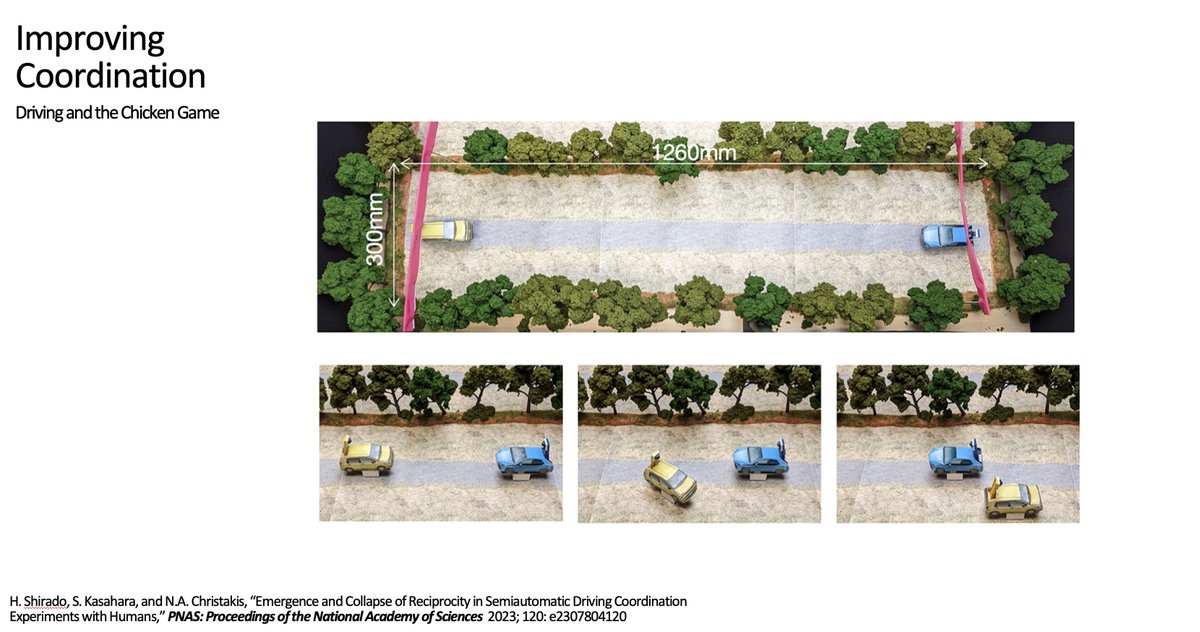
“Emergence and Collapse of Reciprocity in Semiautomatic Driving Coordination Experiments with Humans,” PNAS2023;120:e2307804120. Using remote-control cars in a game of “chicken,” we show that altruism collapses when people leave coordination decisions to machines. https://t.co/s1
2.2K views · 5 likes · 4 reposts · 2 replies Open on X →
“Status Invisibility Alleviates the Economic Gradient in Happiness in Social Network Experiments,” Nature Mental Health 2023;1:990. Making wealth invisible improves the subjective well-being of poor subjects and thus alleviates the economic gradient in SWB. 219 views · 5 likes · 1 reposts · 1 replies Open on X →
“Network Engineering Using Autonomous Agents Increases Cooperation in Human Groups,” iScience 2020;23:101438. Simple AI bots can foster cooperation in human groups by using a re-wiring strategy designed to support the development of cooperative clusters. https://t.co/aPVE4ibG4H 2.5K views · 8 likes · 2 reposts · 1 replies Open on X →
“Resource Sharing in Technologically Defined Social Networks,” Nature Communications 2019;10:1079. Sharing-economy networks are changing the way humans trade and collaborate. These networks can be structured to maximize collective welfare. https://t.co/I98F4ofnCW 10/ 199 views · 3 likes · 0 reposts · 1 replies Open on X →
“Assortative Mixing and Resource Inequality Enhance Collective Welfare in Sharing Networks,” PNAS 2019;116:22442. Resources and ties can be allocated in a network in a way that optimizes collective welfare, but at no increased overall cost. https://t.co/S6uxOJbWrt 11/ 212 views · 4 likes · 1 reposts · 1 replies Open on X →
“Locally Noisy Autonomous Agents Improve Global Human Coordination in Network Experiments,” Nature2017;545:370. AI bots in groups facing a coordination challenge demonstrate the benefits of noise in collective decision making. Bots help humans to help themselves. 193 views · 3 likes · 0 reposts · 1 replies Open on X →
“Intermediate Levels of Network Fluidity Amplify Economic Growth and Mitigate Economic Inequality in Experimental Social Networks,” Sociological Science 2015;2:544. Increasing network fluidity fosters economic growth and lowers inequality, up to a point. https://t.co/t9oyyIdr6x 204 views · 4 likes · 0 reposts · 1 replies Open on X →
“Inequality and Visibility of Wealth in Experimental Social Networks,” Nature 2015;526:426. Making wealth visible in groups lowers overall cooperation, connection, and wealth. High initial levels of economic inequality alone, however, have few bad welfare effects. 221 views · 3 likes · 0 reposts · 1 replies Open on X →
“Static Network Structure Can Stabilize Human Cooperation,” PNAS 2014;111:17093. Consistent with evolutionary game theory, when the benefit-to-cost ratio of cooperation exceeds the average network degree (b/c>k), even a static network structure can stabilize cooperation. 258 views · 3 likes · 0 reposts · 1 replies Open on X →
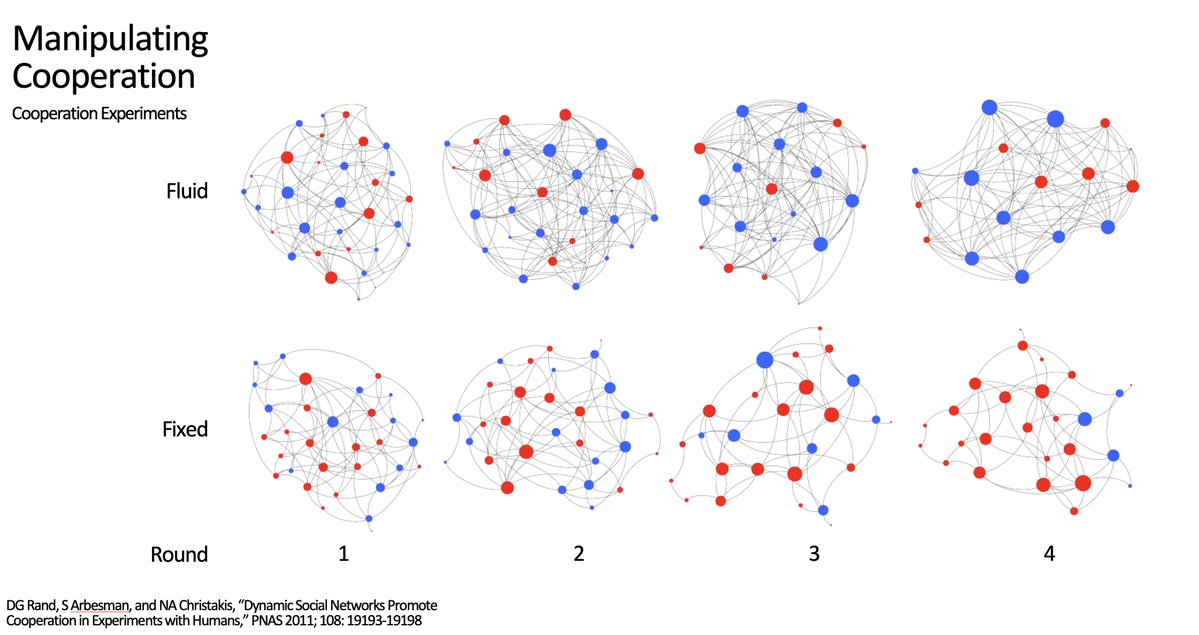
“Quality Versus Quantity of Social Ties in Experimental Cooperative Networks,” Nature Communications 2013;4:2814. There is a Goldilocks effect of network dynamism on cooperation. Optimal levels of cooperation are achieved at intermediate levels of change in social ties. 2.3K views · 7 likes · 2 reposts · 1 replies Open on X →
“Dynamic Social Networks Promote Cooperation in Experiments with Humans,” PNAS 2011;108:19193. Experiments confirm evolutionary game theoretic models, demonstrating important role that dynamic social networks play in supporting large-scale cooperation. https://t.co/UQGONKmowi 4/
2K views · 12 likes · 1 reposts · 1 replies Open on X →
To sustain cooperation and related collective action in human groups, one way is “adding structure” by arranging people in networks or otherwise constraining their interactions (classic review: https://t.co/ZheP9X0f28). We have used experiments to explore this. 2/ 678 views · 4 likes · 1 reposts · 1 replies Open on X →
“Cooperative Behavior Cascades in Human Social Networks,” PNAS 2010;107:5334. These results show experimentally that cooperative behavior cascades in human social networks, to three degrees of separation, via social contagion. https://t.co/lhd8qM9mwn 3/ https://t.co/tQms1YeeP5
2.3K views · 7 likes · 2 reposts · 1 replies Open on X →
What role do social networks – and the precise nature and structure of social interactions – play in the production of public goods and in human welfare? What about social contagion? A thread on #HNL experiments with many thousands of participants from 2010 to the present. 1/ htt
10.8K views · 116 likes · 35 reposts · 2 replies Open on X →
New FLOS video: How to Assemble your Dissertation Committee: https://t.co/dWD1V2YEvI 7.5K views · 5 likes · 1 reposts · 1 replies Open on X →
@PNASNews On the path to machine olfaction. https://t.co/UZN8ilSQGH
1.7K views · 5 likes · 3 reposts · 0 replies Open on X →
@NAChristakis @PNASNews Does this connect with networks via Nietszhe's insistence that people connect by smell? 116 views · 1 likes · 0 reposts · 1 replies Open on X →
Olfaction lacks a quantitative framework similar to vision and hearing. In new #HNL work in @PNASNews, we show that odor mixture perception can be predicted. This lays a foundation for digital olfaction, machine-readable smell metrics, next-generation electronic noses, and 8.1K views · 41 likes · 5 reposts · 2 replies Open on X →
Sometimes, when you are doing research, you become so obsessed with hidden reasons for things that you miss the manifest reasons. https://t.co/wQuAxIc2SX 8K views · 7 likes · 0 reposts · 0 replies Open on X →

เทียบกับบัญชีขนาดเดียวกัน

26 โพสต์จาก 90 วันที่ผ่านมา เทียบกับช่วง 100K–1M ผู้ติดตาม เข้าถึงคนน้อยกว่าบัญชีขนาดเดียวกัน.

ยอดดูมัธยฐาน1 079บัญชีนี้5 886ค่ามัธยฐานของ 100K–1M
การเข้าถึง, %0.58%บัญชีนี้1.87%ค่ามัธยฐานของ 100K–1M
การมีส่วนร่วม, %1.16%บัญชีนี้1.16%ค่ามัธยฐานของ 100K–1M
ตัวชี้วัดบัญชีนี้ค่ามัธยฐานของ 100K–1Mอัตราส่วน
ยอดดูมัธยฐานต่อโพสต์1 0795 8860.18×
การเข้าถึง (ยอดดู ÷ ผู้ติดตาม)0.58%1.87%0.31×
อัตราการมีส่วนร่วม1.16%1.16%0.99×

บัญชีอื่นในช่วงนี้ →   เปรียบเทียบกับบัญชีอื่น →   ค่าอ้างอิงเหล่านี้คำนวณอย่างไร →

Growth & engagement

How the posts we collected actually performed: views and reaction rate post by post, what the audience did with them, and where the follower count goes.

Views per post

20426 Aug
193
212
199
2.5K
219
2.2K
181
182
1.5K
183
1.5K
2827 Aug
6.2K28 Aug

Last 14 collected posts, oldest on the left. The scale is logarithmic: one post can outrun the rest a hundred times over.

Engagement rate per post

2.45%26 Aug
2.07%
2.83%
2.01%
0.44%
3.20%
0.49%
3.87%
3.30%
0.47%
2.73%
0.59%
3.57%27 Aug
0.21%28 Aug

Reactions — likes, reposts, replies and quotes — divided by views. Median for 100K–1M accounts is 1.16%.

What the audience does

Likes55.8%282 in total
Reposts12.1%61 in total
Replies5.1%26 in total
Quotes0.2%1 in total
Bookmarks26.7%135 in total

Share of every reaction we collected for this account. Replies mean argument, reposts mean endorsement, bookmarks mean the post was worth keeping.

The follower curve appears once this account has two daily snapshots — we take one a day, and this one is on its first.

บัญชีที่คล้ายกัน