tweetindex
TH

Ole Peters

@ole_b_peters · joined 09 Nov 2014

Physicist @LdnMathLab, @sfiscience.

30 351Followers
425Following
10 905Posts total
369.8KViews on collected posts

โพสต์ล่าสุด

AI and mathematics. I can't imagine being more bored than by someone who always says the most likely next word. The mathematicians I enjoy are fun because they look for edge cases: what about this thought is not as expected, what would be an unlikely thing to say. 3.8K views · 52 likes · 2 reposts · 4 replies Open on X →
This yellowish liquid they put out in cheap hotels. Is it a prank? It tastes like ground-up PVC with Canderel but pre-coffee is easily mistaken visually for orange juice. https://t.co/g8RPrHNYeT
3.2K views · 21 likes · 0 reposts · 3 replies Open on X →
Interest officially piqued. Christopher Alexander writes about -- hmm. Architecture, perhaps? But it sounds entirely like a critique of economics. A failed rationalist movement, followed by an irrationalist movement doomed to failure. Beautifully articulated. h/t @rjs https://t
2.4K views · 19 likes · 4 reposts · 2 replies Open on X →
@ole_b_peters What would be a more everyday term? 17 views · 0 likes · 0 reposts · 0 replies Open on X →
@ole_b_peters I did have one question on the name: Isn't this technically 'non-ergodicity' economics? Boltzman gave the implicit assumption a name but we are using the exact opposite of that assumption. I did like Prigogine's term of far-from-equilibrium or irreversible but I 155 views · 3 likes · 0 reposts · 2 replies Open on X →
People sometimes ask why we use the term "ergodicity" instead of more everyday terms. I'm always a little surprised by the question. It's the same reason we say 'gravity' and not 'fall-down force' etc. 4K views · 48 likes · 6 reposts · 2 replies Open on X →
@joshuawwy The reason we use the accurate technical term for the problem is that there is 150 years of technical literature associated with it. You can look up the solution to many long-standing problems in economics -- provided you know where to look, hence the word. 3.9K views · 9 likes · 0 reposts · 0 replies Open on X →
@ole_b_peters Hi Ole - would you consider coming on the Fat Tony's Podcast (https://t.co/kdmJCZ72m1) to discuss the book and your work? I would absolutely love to pick you brains about it. 1.8K views · 16 likes · 3 reposts · 2 replies Open on X →
And please stay in touch and tell us what you find. https://t.co/PVszSHKSCM Most of all: enjoy! This is creative, living, science, and I think the fun we had while writing the book shines through on the page. 6.3K views · 68 likes · 4 reposts · 3 replies Open on X →
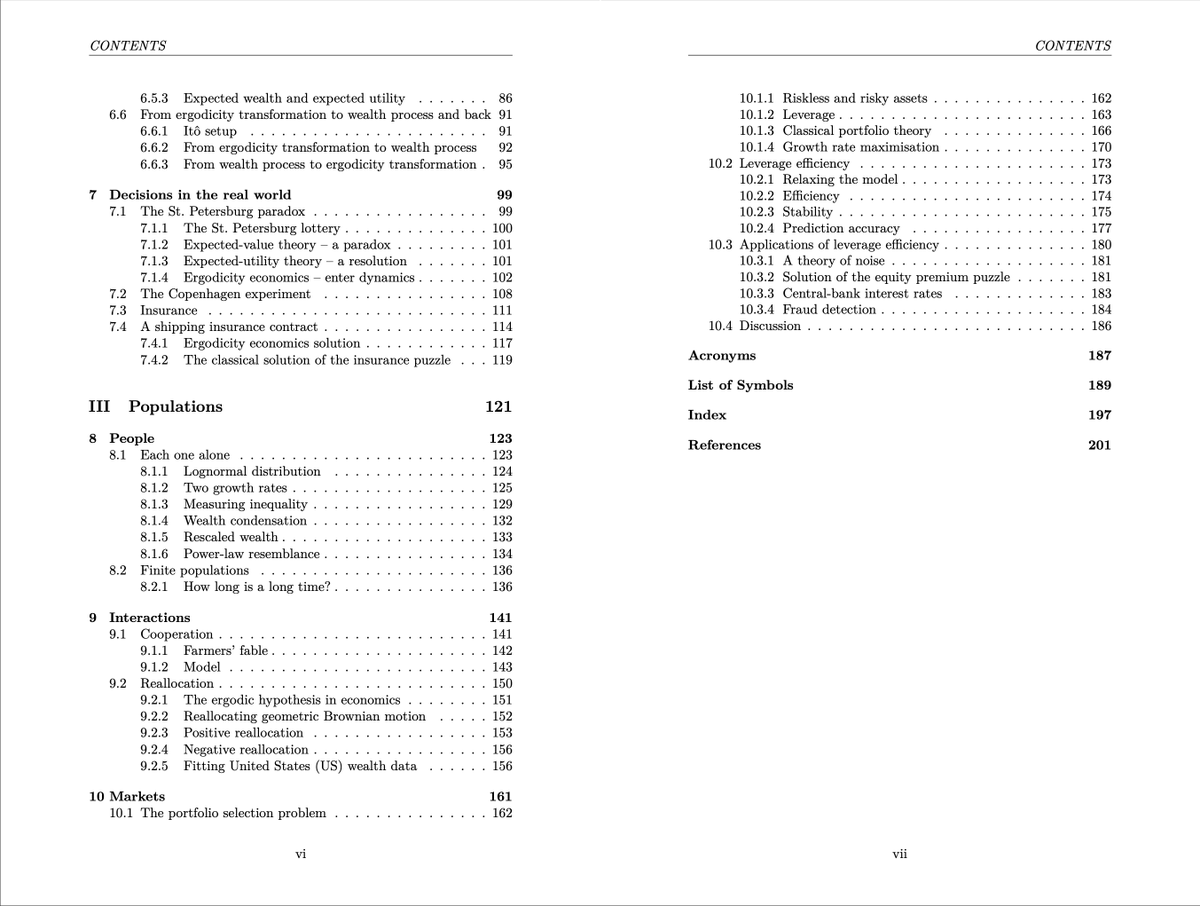
The product is a book that will enable its readers to go far beyond it. It's not a collection of papers, nor a comprehensive survey. It's a launch pad. Absorb what's in this book and take it in entirely new directions. https://t.co/69Cmocnxo4
7.2K views · 55 likes · 2 reposts · 1 replies Open on X →
Then move to collections of individuals, then let them interact. At each level our thinking is informed by the ergodicity problem: how does our perspective change when we move from a statistical-ensemble perspective to a temporal perspective? https://t.co/oRXRfLbOYH
5.9K views · 38 likes · 3 reposts · 1 replies Open on X →
And we ended up with a delightful book. A textbook that you can actually read because it outlines the beginning of a new field. It's deliberate, systematic, and maximally simple. https://t.co/pJPkqaTAC2 6.7K views · 43 likes · 3 reposts · 1 replies Open on X →
We start by introducing tools we found to be useful over the years, wherever they came from. Next we think about a single person making trivial decisions, then increase the complexity of the decisions one step at a time. We create a temporal context, and add ignorance. https://t.
6.6K views · 53 likes · 2 reposts · 1 replies Open on X →
We collected earlier work by researchers who had also asked the ergodicity question, explicitly or implicitly. We traced this problem back over the centuries, found relevant tricks in books on physics, signal processing, economics, mathematics. https://t.co/bqhfqsqxTq 7.1K views · 41 likes · 5 reposts · 1 replies Open on X →
We unified, simplified, and systematized. 6.6K views · 21 likes · 1 reposts · 1 replies Open on X →
Dozens of students worked on smaller projects during @LdnMathLab summer placements. The network of collaborators grew into different domains; machine learning, neuroscience, psychology. https://t.co/BfWKAm44NJ
8K views · 31 likes · 1 reposts · 1 replies Open on X →
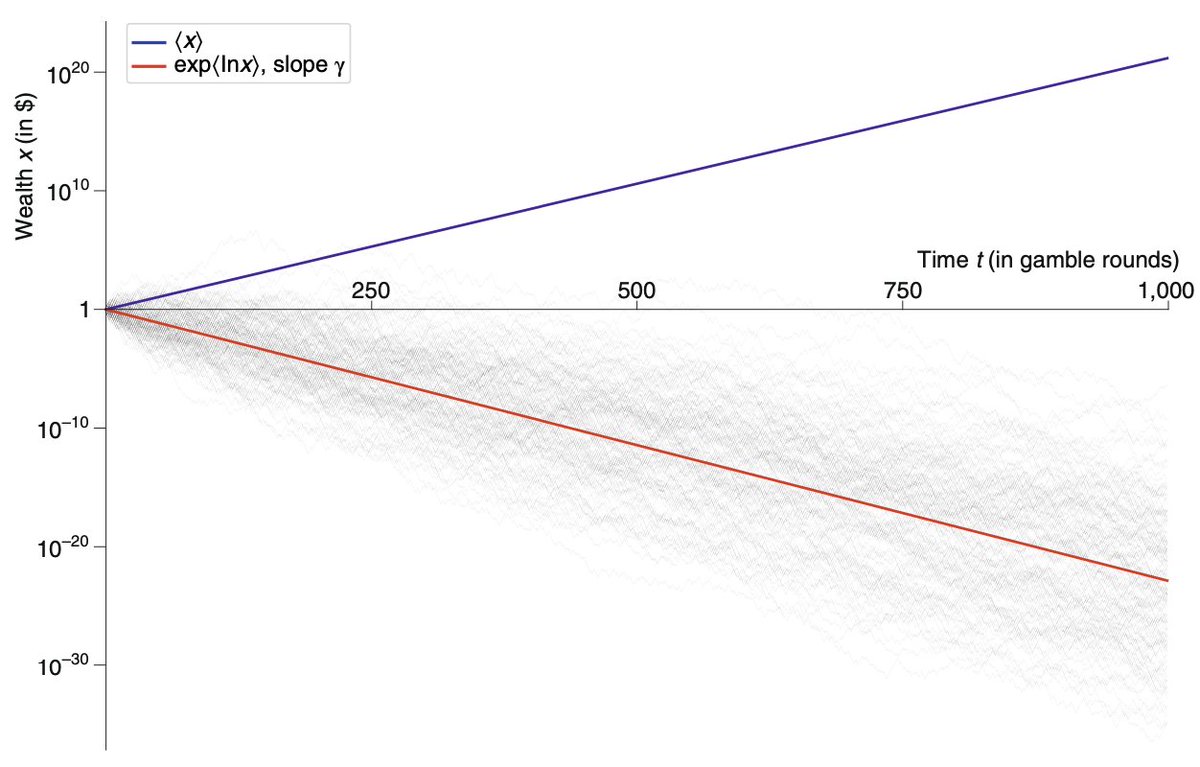
The ergodicity question remained the key to it all: do we think of randomness as variation across time or as variation across multiple systems, real or imagined? So we called what we were doing "Ergodicity economics." https://t.co/vB4JVaeLfS https://t.co/jLz4NFpwJI
8.9K views · 85 likes · 10 reposts · 1 replies Open on X →
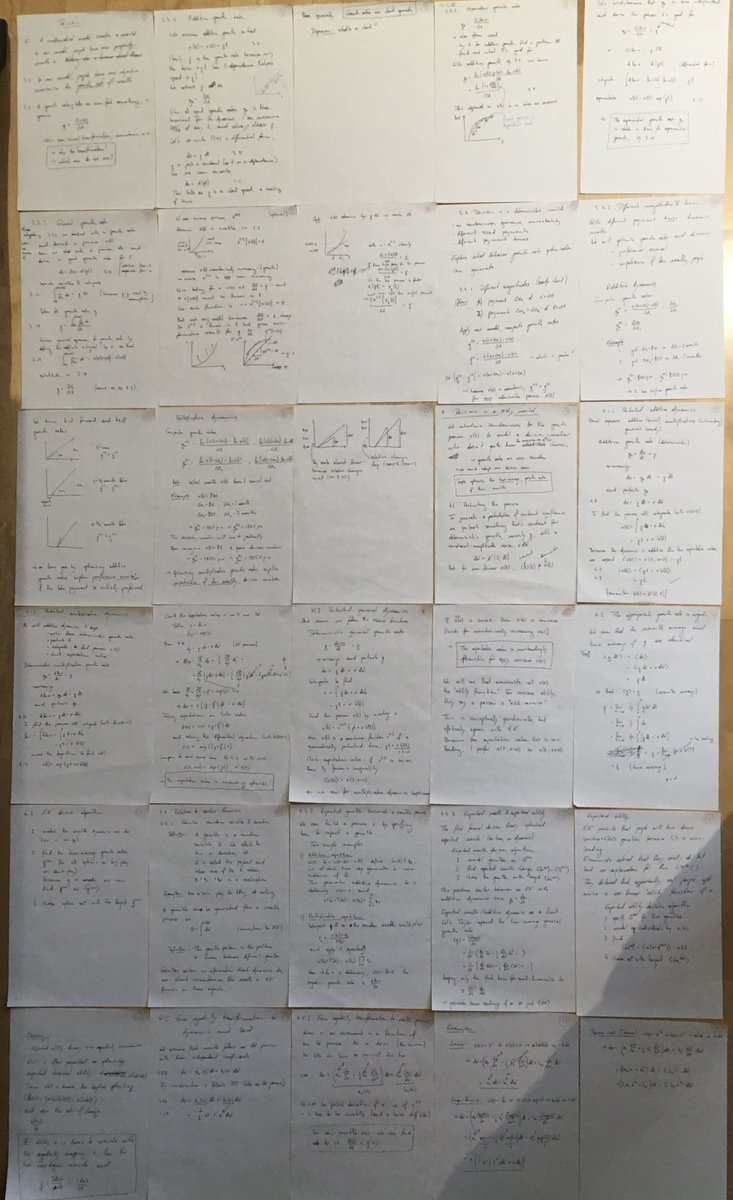
In 2015, I presented a set of lectures on the topic in Chandigarh, India. My haphazard notes for these lectures, co-authored in a rush with Alex Adamou, became a secret classic, with tens of thousands of downloads from my homepage alone. https://t.co/KkRTzMrkka
71K views · 56 likes · 1 reposts · 1 replies Open on X →
Something genuinely new was emerging. While there are several excellent critiques of economic theory, including by some of its key architects, what we were developing was a constructive alternative. 8K views · 32 likes · 1 reposts · 1 replies Open on X →
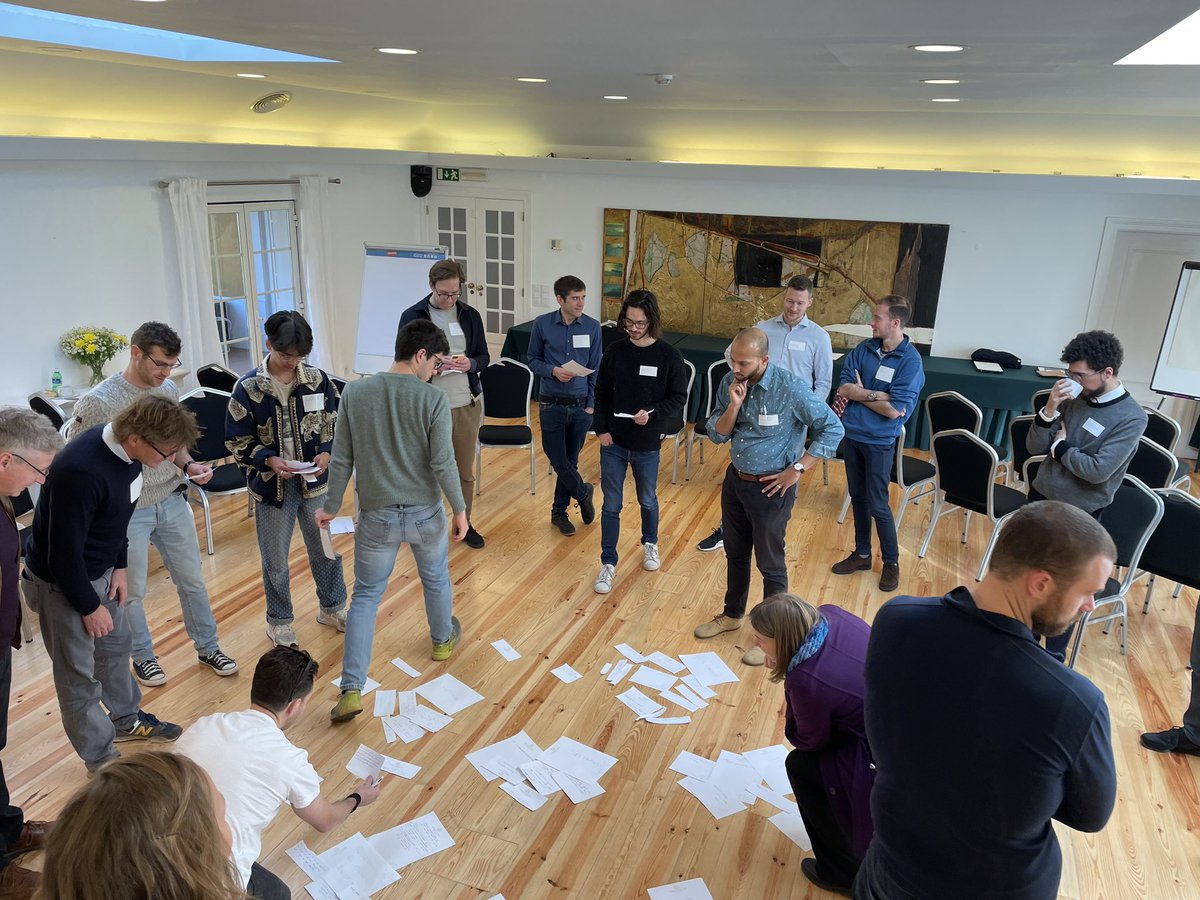
In 2012 I set up @LdnMathLab to host a research group dedicated to the project, with young and curious minds rotating in and out over the years. It would take too long to list them all, but my co-author @alex_adamou stayed for 10 years. https://t.co/yg1ytborTi
9.5K views · 32 likes · 1 reposts · 1 replies Open on X →
Our work also attracted philanthropists, and I continue to benefit from their support; financial, moral, strategic, managerial. 8.9K views · 24 likes · 1 reposts · 1 replies Open on X →
I benefited immensely from their encouragement and their generosity with their time. 9K views · 29 likes · 1 reposts · 1 replies Open on X →
This work soon attracted the attention of some extraordinary thinkers. I had met them because we were all members of the community around the Santa Fe Institute @sfiscience. Among them were Murray Gell-Mann, Ken Arrow, Reuben Hersh, and Cormac McCarthy. https://t.co/WVOxbvk7HD
10.4K views · 65 likes · 3 reposts · 2 replies Open on X →
1/thread🧵 Almost 20 years ago, I started thinking about the ergodicity problem in the context of economics. That turned out to be surprisingly fruitful, and now there's a book about it. https://t.co/gNLRpqNbiI
170.5K views · 1.2K likes · 155 reposts · 36 replies Open on X →

เทียบกับบัญชีขนาดเดียวกัน

7 โพสต์จาก 90 วันที่ผ่านมา เทียบกับช่วง 10K–100K ผู้ติดตาม แสดงในวงกว้าง แต่มีผู้ชมตอบสนองน้อย.

ยอดดูมัธยฐาน3 248บัญชีนี้975ค่ามัธยฐานของ 10K–100K
การเข้าถึง, %10.70%บัญชีนี้3.61%ค่ามัธยฐานของ 10K–100K
การมีส่วนร่วม, %1.02%บัญชีนี้1.94%ค่ามัธยฐานของ 10K–100K
ตัวชี้วัดบัญชีนี้ค่ามัธยฐานของ 10K–100Kอัตราส่วน
ยอดดูมัธยฐานต่อโพสต์3 2489753.33×
การเข้าถึง (ยอดดู ÷ ผู้ติดตาม)10.70%3.61%2.96×
อัตราการมีส่วนร่วม1.02%1.94%0.53×

บัญชีอื่นในช่วงนี้ →   เปรียบเทียบกับบัญชีอื่น →   ค่าอ้างอิงเหล่านี้คำนวณอย่างไร →

Growth & engagement

How the posts we collected actually performed: views and reaction rate post by post, what the audience did with them, and where the follower count goes.

Views per post

7.1K17 May
6.6K
6.7K
5.9K
7.2K
6.3K
1.8K
3.9K20 Aug
4K
155
17
2.4K23 Aug
3.2K28 Aug
3.8K4 Sep

Last 14 collected posts, oldest on the left. The scale is logarithmic: one post can outrun the rest a hundred times over.

Engagement rate per post

0.66%17 May
0.84%
0.71%
0.71%
0.81%
1.19%
1.16%
0.23%20 Aug
1.40%
3.23%
0.00%
1.02%23 Aug
0.74%28 Aug
1.54%4 Sep

Reactions — likes, reposts, replies and quotes — divided by views. Median for 10K–100K accounts is 1.94%.

What the audience does

Likes53.1%2 034 in total
Reposts5.5%209 in total
Replies1.8%69 in total
Bookmarks39.7%1 521 in total

Share of every reaction we collected for this account. Replies mean argument, reposts mean endorsement, bookmarks mean the post was worth keeping.

The follower curve appears once this account has two daily snapshots — we take one a day, and this one is on its first.

บัญชีที่คล้ายกัน