tweetindex
EN

Arin Dube

@arindube · Northampton/Somerville, MA · joined 03 Jun 2013

Provost Prof. of Economics, UMass Amherst Labor market policies, competition, inequality @nberpubs My book: https://t.co/MbU5UIMtqx

57 963Followers
1 069Following
39 721Posts total
467.8KViews on collected posts

Latest posts

I learned 3 new things today, thanks to AI (Fable). Here's what it did, and what it did not do. Each of the 3 things was a conjecture I had involving empirical patterns, sometimes requiring corrections for measurement error. None of the conjectures came from Fable. And in some 11.2K views · 101 likes · 18 reposts · 5 replies Open on X →
I think most American voters would be surprised and alarmed if they learned that many leading Silicon Valley AI figures: 1) believe that AGI (artificial general intelligence, or the idea that AI that can pretty much do any cognitive task a human can, making it a substitute for 134K views · 649 likes · 92 reposts · 44 replies Open on X →
You don't need a PhD to be a professional economist. Plenty of public and private sector economist positions do not require a PhD. And I don't see why we keep having this somewhat silly debate over and over again. Focus on the quality of the argument, not credentials. 42.4K views · 202 likes · 17 reposts · 24 replies Open on X →
As an American voter, if you find this economic warfare on our neighbor and ally to be an absurd abomination, remember that there is something you can do about it: vote for a Democrat this November. https://t.co/162ZuF6lDQ https://t.co/tEDuwxcjNF
2K views · 25 likes · 5 reposts · 2 replies Open on X →
@LizShuler @DAcemogluMIT @RoKhanna @SohrabAhmari This from my PhD advisor Richard Freeman on the importance of sectoral bargaining and extension of contracts is exactly right. I dive into this in The Wage Standard. https://t.co/pMcr48B89k 3.2K views · 18 likes · 6 reposts · 0 replies Open on X →
Richard Freeman with @deanbaker13 on #MostlyEconomics: US union decline is largely driven by companies fighting hard against unionization + weak gov't pushback + workplace-by-workplace bargaining. While Europe extends contracts industry-wide fueling greater union density. https:/
1:06
4.2K views · 5 likes · 1 reposts · 0 replies Open on X →
@arindube Re: Productivity is there a way to impute non wage benefits for total compensation for different deciles? I know you can do it for the median hourly wage, that's what EPI and others have done. 351 views · 1 likes · 0 reposts · 0 replies Open on X →
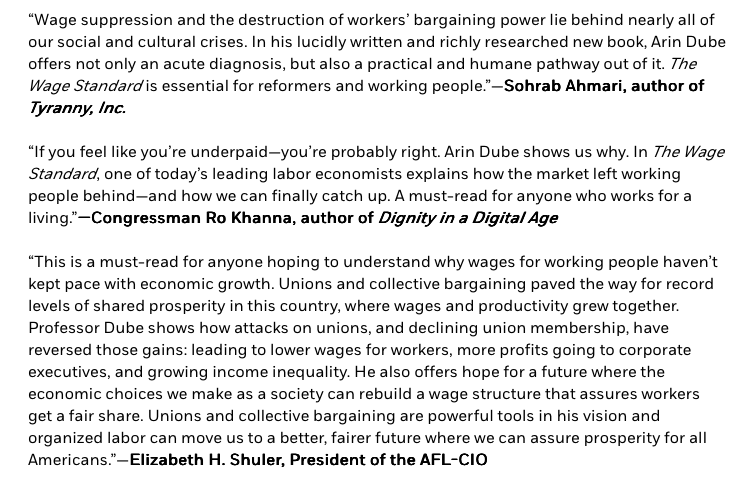
Finally, want to thank the early praise from an amazing set of thought leaders. Including @LizShuler, @DAcemogluMIT, @RoKhanna, @SohrabAhmari, David Card, Jim Robinson \End https://t.co/9Y9tELr8vf
3.3K views · 21 likes · 3 reposts · 1 replies Open on X →
But to really reach the middle class, we need to think more broadly. This is where sectoral standards come in. For example, wage boards that set pay floors for occupations across an industry or state, so the going rate reflects a social standard, not just the lowest-paying 1.6K views · 18 likes · 3 reposts · 1 replies Open on X →
Other rich countries use wage boards and sectoral bargaining to ensure typical workers share in growth. Some US states and cities are now experimenting too. Our wage standard is not fixed by nature; it’s a set of choices. 1.4K views · 20 likes · 3 reposts · 2 replies Open on X →
The lesson of the past 40 years is that inclusive growth isn’t automatic. The encouraging lesson of the past 10 is that we’re not stuck with the status quo. Broadly shared prosperity can - and should - be a normal part of economic progress. 2.1K views · 20 likes · 2 reposts · 1 replies Open on X →
But macro isn’t enough. At the micro level, we also need scalpels: banning noncompete clauses and no-poach agreements, limiting abusive scheduling. Rules that make it easier for workers to walk away and push firms to raise pay. 2.1K views · 32 likes · 3 reposts · 1 replies Open on X →
Still, neither macro nor micro alone can reliably rebuild the middle. That’s where meso-level wage standards come in. This includes minimum wages, which set a floor for low-wage work and have helped compress inequality without the big job losses many feared. The Wage 1.8K views · 22 likes · 3 reposts · 1 replies Open on X →
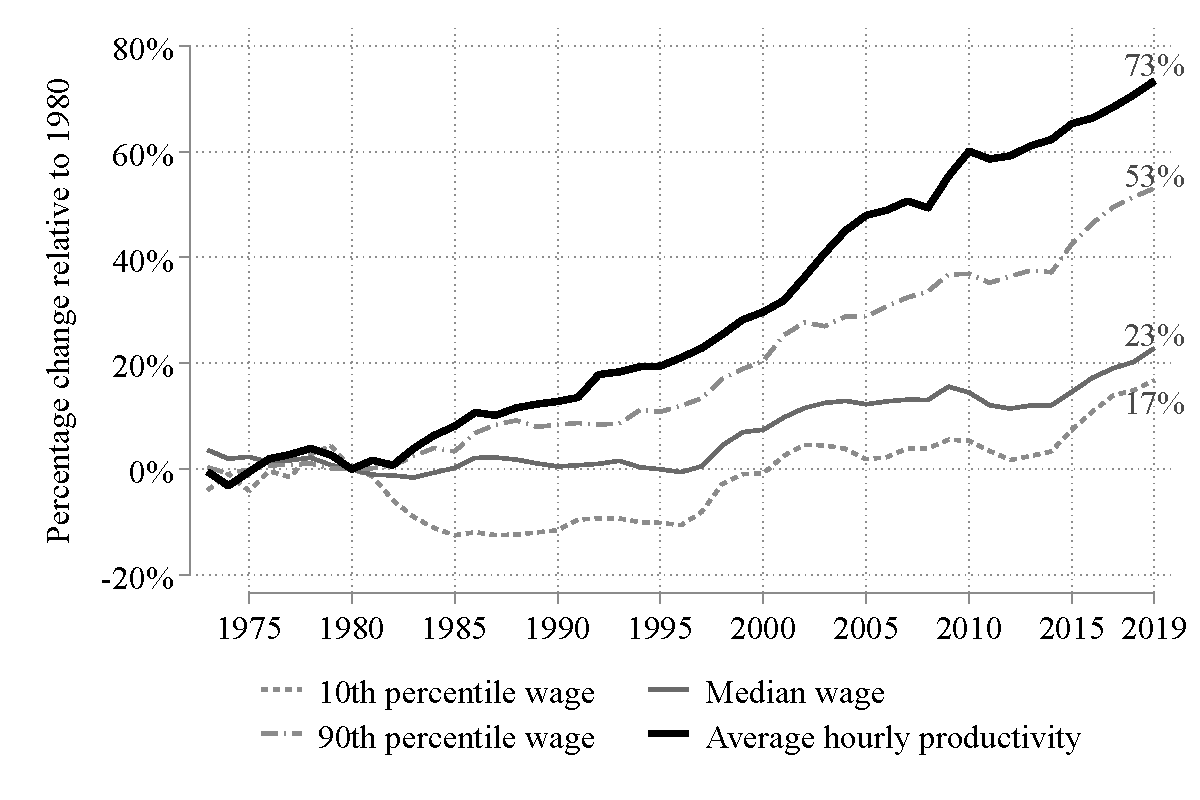
A unifying theme in the book is an important idea with a funny name: monopsony. When employers have power because workers can’t easily switch jobs, they can hold wages below productivity. The pay–productivity gap is what a monopsonistic labor market looks like in practice. And 4K views · 40 likes · 4 reposts · 1 replies Open on X →
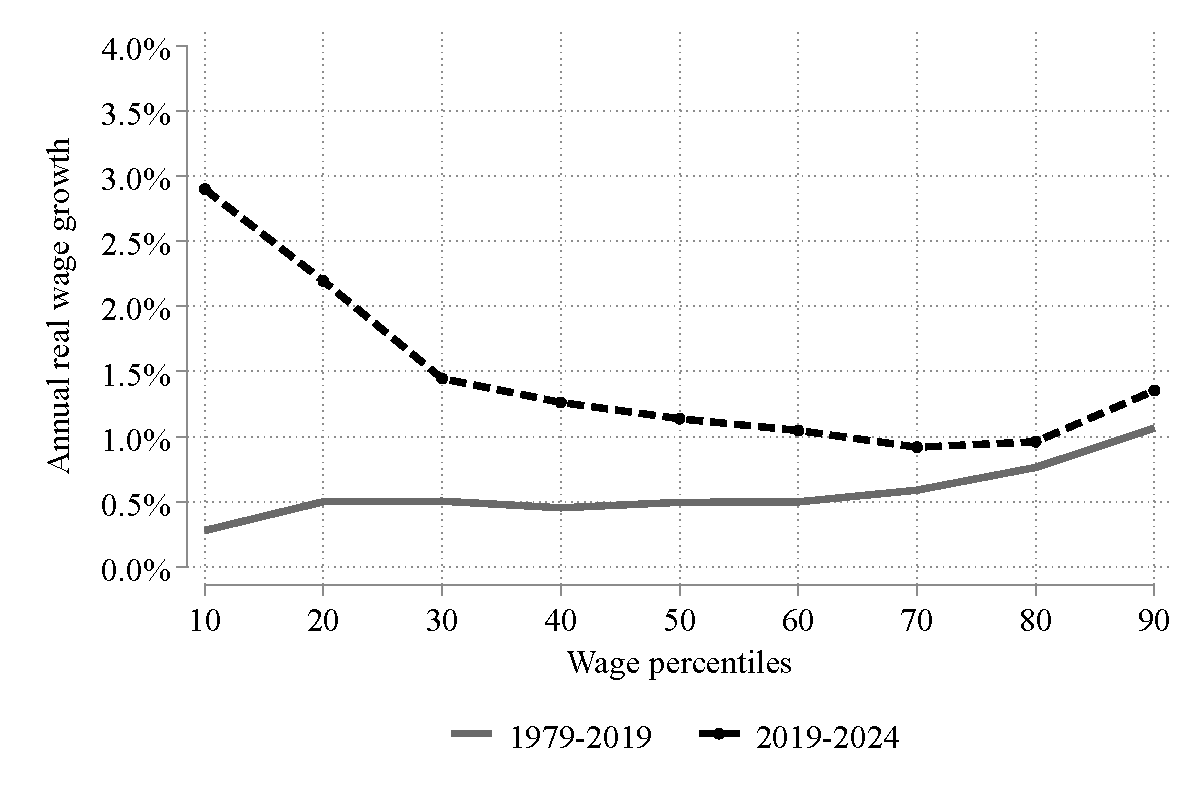
Recent years showed what happens when we run the economy hot: a tight labor market forced employers to compete for workers, especially at the bottom. Macro policy aimed at true full employment is one of the strongest antidotes to monopsony. 3.9K views · 40 likes · 3 reposts · 1 replies Open on X →
Between 1979–2019, top pay (90th pct.) rose 53%, middle rose 23%, bottom (10th pct.) rose 17%. (Hourly productivity climbed 73%.) Since 2019, gains at the bottom reversed 1/3 of this rise in pay inequality. But much more needs to be done! 🧵on my book: The Wage Standard. http
180.3K views · 246 likes · 49 reposts · 14 replies Open on X →
What's behind the ebbs and flows in wages over the past century? That’s what my forthcoming book, The Wage Standard, is all about: how rules, norms, and power in the labor market shape who shares in growth. Coming out March 31. Pre-order here: https://t.co/UG2rv4a1Oc 70.2K views · 77 likes · 8 reposts · 1 replies Open on X →

Against accounts of the same size

4 posts from the last 90 days, next to the 10K–100K follower range. shown widely, but few of those viewers react.

Median views26 774this account999median for 10K–100K
Reach, %46.19%this account3.62%median for 10K–100K
Engagement, %0.86%this account1.92%median for 10K–100K
MetricThis accountMedian for 10K–100KRatio
Median views per post26 77499926.8×
Reach (views ÷ followers)46.19%3.62%12.8×
Engagement rate0.86%1.92%0.45×

Others in this range →   Compare with another account →   How these benchmarks are built →

Growth & engagement

How the posts we collected actually performed: views and reaction rate post by post, what the audience did with them, and where the follower count goes.

Views per post

4K11 Dec
1.8K
2.1K
2.1K
1.4K
1.6K
3.3K
351
4.2K
3.2K
2K22 Aug
42.4K23 Aug
134K
11.2K27 Aug

Last 14 collected posts, oldest on the left. The scale is logarithmic: one post can outrun the rest a hundred times over.

Engagement rate per post

1.15%11 Dec
1.47%
1.70%
1.11%
1.79%
1.39%
0.77%
0.28%
0.17%
0.75%
1.61%22 Aug
0.59%23 Aug
0.60%
1.13%27 Aug

Reactions — likes, reposts, replies and quotes — divided by views. Median for 10K–100K accounts is 1.92%.

What the audience does

Likes67.0%1 537 in total
Reposts9.6%220 in total
Replies4.3%99 in total
Quotes1.6%36 in total
Bookmarks17.5%401 in total

Share of every reaction we collected for this account. Replies mean argument, reposts mean endorsement, bookmarks mean the post was worth keeping.

The follower curve appears once this account has two daily snapshots — we take one a day, and this one is on its first.

Similar accounts