tweetindex
EN

Ashley Miller ✓

@icmteaching · United Kingdom · joined 06 Dec 2015

#FUSIC Haemodynamics National Lead. ICS trustee. BSE level 2. BJJ ⬛️⬛️🟥⬛️ @Turningthe_Tide #foamed #pocus #haemodynamics

10 937Followers
853Following
6 733Posts total
173.8KViews on collected posts

Latest posts

The Surviving Sepsis Campaign has shaped sepsis care for decades. But do some of its core recommendations now lag behind the physiology and the evidence? Rory Spiegel @TheEMNerd led this new dissenting opinion, which I was very pleased to contribute to. We challenge: • fixed
8.2K views · 99 likes · 33 reposts · 7 replies Open on X →
Next up on The Dependent Variable: a two-part dive into acid–base physiology. Not Stewart versus Henderson–Hasselbalch. Both can be correct. The more interesting question is: Which variables are independent, which are dependent, and which equations are simply different 2.7K views · 40 likes · 14 reposts · 1 replies Open on X →
High praise (exaggerated I think) from one of the greatest POCUS educators of our time 🙌🏻 14.9K views · 115 likes · 13 reposts · 2 replies Open on X →
Afterload is not SVR. It is not simply arterial pressure. And the same arterial load does not impose the same myocardial load on every heart. In this week’s The Dependent Variable: – why the ventricle really does eject against pressure – why resistance matters because it 1.6K views · 24 likes · 4 reposts · 0 replies Open on X →
@icmteaching @Wilkinsonjonny @ThinkingCC @ross_prager @NephroP @RafaelOliveLeit @iceman_ex @sn1shibazaki All your 🧵 can be a 📖 !! Thx Ashley ! 1.8K views · 9 likes · 0 reposts · 1 replies Open on X →
@icmteaching @Wilkinsonjonny @ThinkingCC @ross_prager @NephroP @RafaelOliveLeit @iceman_ex @sn1shibazaki https://t.co/0Po1epUMsD
GIF
484 views · 7 likes · 0 reposts · 0 replies Open on X →
@icmteaching @Wilkinsonjonny @ThinkingCC @ross_prager @NephroP @iceman_ex @sn1shibazaki Great! Looking forward for brave and boldly innovative ideas! 302 views · 4 likes · 0 reposts · 0 replies Open on X →
I’ve started a Substack: The Dependent Variable. X is great for short-form discussion, but it’s not ideal for building a coherent archive. This will be the home for longer-form writing on cardiovascular physiology, haemodynamics, fluids, shock, ultrasound and critical care http
75.9K views · 223 likes · 48 reposts · 10 replies Open on X →
@icmteaching Fantastic clarification on microcirculation! Appreciating these intricate details truly drives healthcare forward. Such insights reflect the innovative spirit we need! 150 views · 2 likes · 0 reposts · 0 replies Open on X →
Want a simpler, more clinically focussed, explanation? Try this 👇🏻 1.9K views · 6 likes · 1 reposts · 0 replies Open on X →
1️⃣ We talk a lot about “capillary leak.” But the term is often misunderstood. Fluid doesn’t simply pour out of “leaky” vessels – it follows the same physics every time. Getting this right changes how we think about fluids 👇 https://t.co/XI6XFKhtDk
0:06
5K views · 30 likes · 15 reposts · 2 replies Open on X →
Start here 👇 https://t.co/bIAqMDAayw 2.7K views · 9 likes · 3 reposts · 1 replies Open on X →
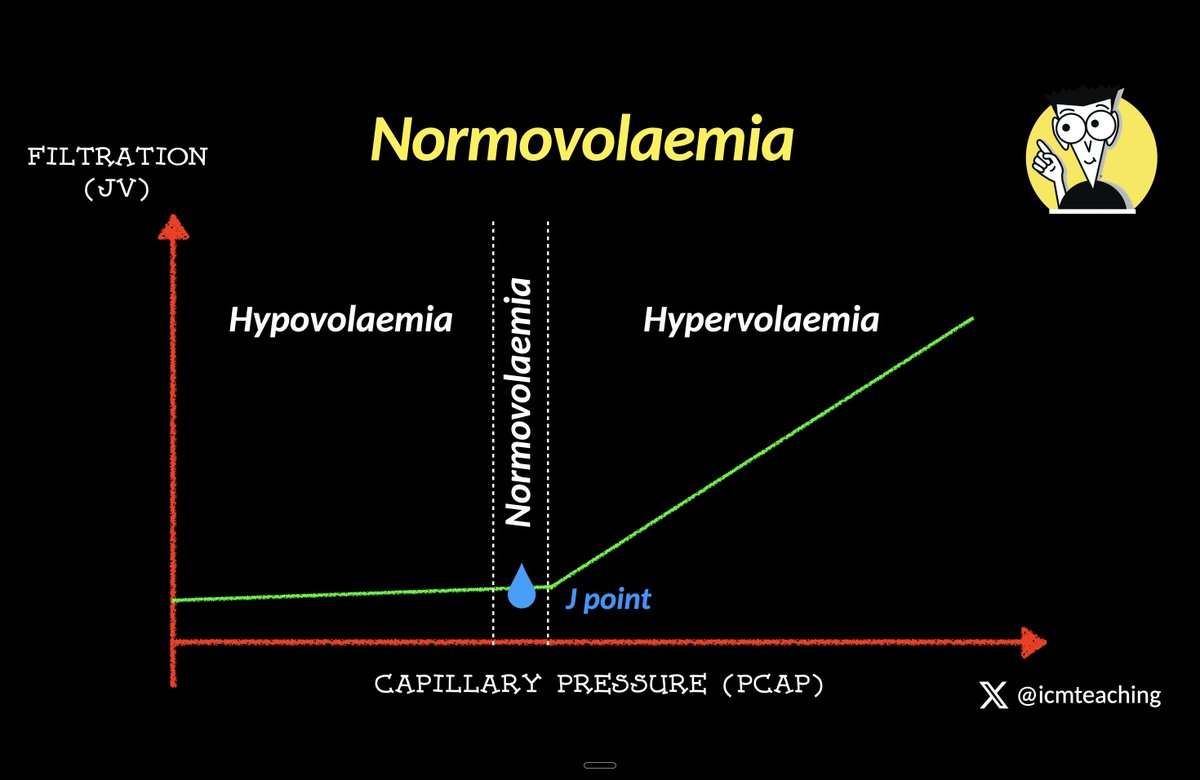
1️⃣3️⃣ Take-away • Pc is the main driver of Jv • The glycocalyx, not the interstitium, sets the oncotic barrier • Re-absorption is transient; lymphatics handle steady-state return • We live just left of the J-point – safe, efficient, balanced Cross it, and filtration runs away 1.3K views · 12 likes · 2 reposts · 1 replies Open on X →
1️⃣4️⃣ Next in the series In the next thread we’ll see how this explains the paradox of renal replacement therapy: 👉 How you can remove 12 mL/kg/h of fluid without collapsing the circulation. #MedX #ICU #Physiology #FluidTherapy 1.5K views · 15 likes · 4 reposts · 4 replies Open on X →
1️⃣2️⃣ Lymphatics – the silent partner Every day ≈ 10 L of plasma water filters through our capillaries (≈ 400 mL/h) and almost every drop returns via the lymphatics. Re-absorption at the venous end? ≈ 0. Without lymph flow, the entire extracellular space would swell within 1.3K views · 14 likes · 4 reposts · 1 replies Open on X →
1️⃣1️⃣ Operating range In euvolaemia we live just left of the J-point – enough filtration to sustain lymph flow, but below the runaway zone. Small Pc rises (vasodilation, congestion, fluid loading) push us rightward → oedema. Small Pc falls (UF, vasoconstriction) move us left → h
5.1K views · 32 likes · 12 reposts · 1 replies Open on X →
🔟 The J-shaped relationship At low Pc, filtration is minimal and can even cease. As Pc rises, albumin under the glycocalyx is washed out, strengthening the oncotic brake and keeping Jv flat. Once all albumin beneath the glycocalyx is gone, the brake fails and filtration shoots 1.5K views · 11 likes · 2 reposts · 4 replies Open on X →
9️⃣ Re-absorption When Pc drops, a small volume of interstitial fluid can move back – but the sub-glycocalyx layer quickly fills with protein, collapsing the oncotic gradient. Reverse flow stops within minutes, giving only a brief autotransfusion of ~300–500 mL that helps preserv 1.5K views · 13 likes · 3 reposts · 2 replies Open on X →
8️⃣ How Pc is controlled Pc sits between arterial and venous pressures. Arterioles drop most of the pressure: when they constrict, Pc falls; when they dilate, Pc rises. Venous pressure transmits almost directly – so congestion or raised RAP pushes Pc up almost 1-for-1. → 1.5K views · 11 likes · 3 reposts · 1 replies Open on X →
7️⃣ The protein-washout effect Filtrate flowing through the glycocalyx and endothelial clefts washes out albumin, preventing its diffusion back toward the plasma. That leaves the sub-glycocalyx layer nearly protein-free, maintaining a strong oncotic gradient (πc – πg) even though
1.9K views · 12 likes · 4 reposts · 2 replies Open on X →
6️⃣ The paradox If albumin is present both within the capillary and in the interstitium, why does an oncotic gradient still exist? Because the effective gradient isn’t between plasma and interstitium – it’s between plasma and the underside of the glycocalyx (πg) which is almost 1.7K views · 11 likes · 3 reposts · 1 replies Open on X →
5️⃣ Albumin A key player here is albumin – the main plasma protein generating oncotic pressure. The glycocalyx is largely impermeable to albumin, but it still crosses through occasional large junctions and vesicular routes. It exists on both sides of the capillary wall (≈ 40 % in 1.7K views · 11 likes · 3 reposts · 1 replies Open on X →
4️⃣ The Glycocalyx – the forgotten structure Capillaries are lined by a spongy layer called the glycocalyx – a water-gel containing about 1 L of our intravascular volume. It’s the body’s microscopic filter and seal, trapping albumin in its outer layer 🧬 1.7K views · 11 likes · 2 reposts · 1 replies Open on X →
3️⃣ The extended Starling principle Jv = Lp · S · ( (Pc − Pi) − σ · (πc − πg) ) • Pc – capillary hydrostatic pressure • Pi – interstitial pressure • πc – plasma oncotic pressure • πg – oncotic pressure just beneath the glycocalyx (the effective gradient) That thin, 2K views · 12 likes · 3 reposts · 1 replies Open on X →
2️⃣ The old picture Starling (1896) imagined that filtration dominates early in the capillary and re-absorption later, where pressure is lower. In most tissues, direct re-absorption almost never happens. Capillary pressure (Pc) slightly exceeds oncotic pressure along the whole 2K views · 15 likes · 4 reposts · 1 replies Open on X →
1️⃣We talk endlessly about “capillary leak” – but most of what we say about it is wrong. Here’s what actually drives fluid movement across the microcirculation – and why Starling’s model needed an upgrade. A 🧵👇 https://t.co/r3V0ciCPyW
0:06
20.7K views · 134 likes · 59 reposts · 6 replies Open on X →
🧵 Lymphangions: The Hidden Pump Protecting You From Oedema 1️⃣ What if I told you that you have hundreds of tiny hearts quietly pumping litres of fluid every day? They’re called lymphangions—segments of your lymphatic system that actively contract to return interstitial fluid to 13K views · 78 likes · 47 reposts · 4 replies Open on X →

Against accounts of the same size

4 posts from the last 90 days, next to the 10K–100K follower range. shown to more people than peers of the same size.

Median views5 442this account924median for 10K–100K
Reach, %49.76%this account3.62%median for 10K–100K
Engagement, %1.75%this account1.52%median for 10K–100K
MetricThis accountMedian for 10K–100KRatio
Median views per post5 4429245.89×
Reach (views ÷ followers)49.76%3.62%13.8×
Engagement rate1.75%1.52%1.15×

Others in this range →   Compare with another account →   How these benchmarks are built →

Growth & engagement

How the posts we collected actually performed: views and reaction rate post by post, what the audience did with them, and where the follower count goes.

Views per post

1.5K6 Nov
1.3K
2.7K
5K
1.9K7 Nov
1509 Nov
75.9K9 Jun
302
484
1.8K10 Jun
1.6K14 Sep
14.9K18 Sep
2.7K21 Sep
8.2K22 Sep

Last 14 collected posts, oldest on the left. The scale is logarithmic: one post can outrun the rest a hundred times over.

Engagement rate per post

1.52%6 Nov
1.17%
0.49%
0.99%
0.38%7 Nov
1.33%9 Nov
0.38%9 Jun
1.32%
1.45%
0.55%10 Jun
1.74%14 Sep
0.87%18 Sep
2.06%21 Sep
1.75%22 Sep

Reactions — likes, reposts, replies and quotes — divided by views. Median for 10K–100K accounts is 1.52%.

What the audience does

Likes47.2%960 in total
Reposts14.1%286 in total
Replies2.7%55 in total
Quotes1.0%21 in total
Bookmarks35.0%713 in total

Share of every reaction we collected for this account. Replies mean argument, reposts mean endorsement, bookmarks mean the post was worth keeping.

The follower curve appears once this account has two daily snapshots — we take one a day, and this one is on its first.

Similar accounts